








Qatar now expects production from its massive North Field East LNG expansion to start up in 2027, according to HE Saad Sherida Al-Kaabi , Qatar’s Energy Minister, CEO and president of QatarEnergy
Speaking at the Qatar Economic Forum, Powered by Bloomberg: UNGA Special Edition 2026 in New York, the Minister said the first production train at North Field East – the initial phase of Qatar’s LNG expansion – is expected to come online in the first half of 2027 as shipping disruptions in the Strait of Hormuz slow projects across the country’s economy. It had previously been expected to start production this year.
Tightening LNG supplies
The world's largest single non-associated gas field, the North Field, spanning over 6,000 sq. km, represents 20% of the world's total gas reserves. Qatar’s North Field expansion projects aim to raise LNG production capacity to 142mn tons per annum (MTPA) before the end of this decade. The North Field South project – the second phase of the expansion – is slated to come online in 2028, Al-Kaabi said – but these timings will depend on what happens in the Hormuz Strait and the ability to get facilities coming in.
The timeline reinforces the expectations that the near-closure of the Strait of Hormuz due to the Iran war threatens to tighten global LNG supplies for years, Bloomberg comments. Disruptions have already cut LNG supplies from Qatar — the world’s second largest LNG exporter and a key supplier to both the Asian and European markets — sending spot prices surging to the highest level since 2022 in Asia and Europe.
Qatar’s Ras Laffan plant, which produced nearly a fifth of the world’s LNG before the war began in February, can resume operations at undamaged parts of the facility “within a couple of weeks” when Hormuz reopens, the Minister said. The attack on Ras Laffan early on in the conflict resulted in damage to two LNG trains and Shell’s GTL plant, prompting Qatar to declare force majeure to its affected buyers.
“Repairs on the GTL train will be concluded in the first quarter of 2027. However, it will take three years for repairs on the two LNG trains,” the Minister said.
Qatar is currently exporting a very small amount of LNG through the Strait, Al-Kaabi said, adding that Doha has decided not to build bypass pipelines.
“LNG, our main export commodity, cannot be transported by pipelines. We will have to transport it by pipelines as gas and then liquify it at the receiving terminal, wherever that may be. This means we are building reductant facilities to the ones we are already building in Qatar as part of the North Field expansion project. This makes no economic sense.”
Diversifying options
Qatar is pivoting to become a larger trader of LNG in the meantime, and is handling more LNG outside of the Persian Gulf with the start of its Golden Pass export facility in the US. Shipments have started from the first train.
“We expect next year to have both the second and third trains in full operations. We are also building the largest ethane cracker in the world at the Golden Triangle Polymers Project.” The project will be starting up in the next few weeks, he said.
“We will be, in the very near future, the largest LNG trader in the world by far,” said Al-Kaabi. “And we’re building our position to become the largest trader.”
Qatar's Energy Minister warns of delay to LNG expansion projects
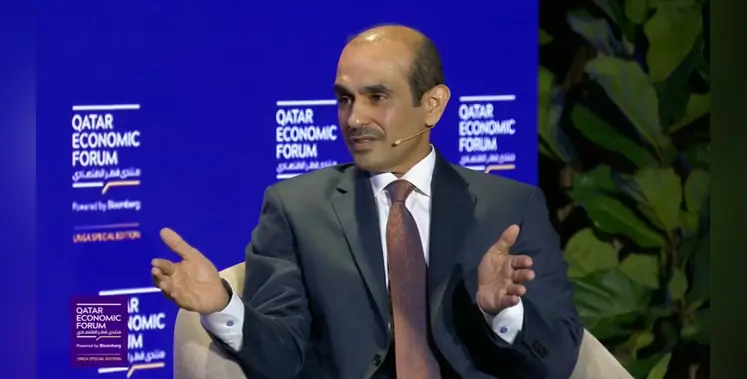
HE Saad Sherida Al-Kaabi , Qatar’s Energy Minister, CEO and president of QatarEnergy speaking at the Qatar Economic Forum. (Image source: QatarEnergy)