






vc.web.local

twitter linkedinfacebookacp contact us

Event News

The experts discussed how rapidly energy data is evolving.

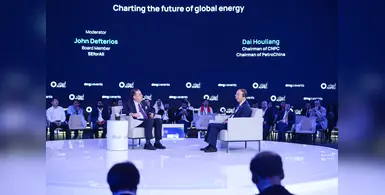
Exploring the concepts of energy market transparency, carbon management, and hydrogen market development, high-level meetings at the International Energy Forum in Riyadh saw senior officials and experts from governments, industry, and international organisations

The experts discussed how rapidly energy data is evolving, backed by dynamic digital solutions delivering timely, consistent, high-quality information. Transparent benchmarks such as JODI's responsibility in reflecting quality data with streamlined reporting holds immense significance in shaping global energy security and sound policy planning. The growing need for transparency across LNG, hydrogen and its derivatives, renewables, carbon management, and critical minerals were also discussed. 

The following day, the IEF and Japan's Organization for Metals and Energy Security (JOGMEC) co-hosted a High-Level Roundtable on Building Carbon Management and Hydrogen Markets. There were exchanges on policy frameworks, investment signals, and cooperation opportunities for scale emerging carbon and hydrogen value chains. 

An inter-secretariat meeting of JODI partner organisations including APEC, GECF, IEA, IEF, OLADE and OPEC led to a forward-looking roadmap to strengthen the global energy-data reporting framework, build institutional capacity, and expand JODI coverage in line with emerging challenges. The outcomes will guide future work programmes and reinforce global transparency efforts that support energy security, affordability, and sustainability.

"By collaborating with JODI organizations and others to improve data quality and availability, align reporting, and build capacity, we strengthen transparency and support better data for better decisions. Through the IEF's neutral and inclusive platform, which gives voice to all, we also act as a catalyst for cooperation in emerging areas such as carbon management and hydrogen markets. This collective effort contributes to more resilient and secure energy pathways," said IEF secretary general, Jassim Alshirawi.

Jesus Hernandez, senior vice president for EMEA at AVEVA, shared a compelling overview of the company’s strategic priorities and technological ambitions during a recent discussion at ADIPEC 2025.

Central to his message was AVEVA’s dedication to harnessing the power of industrial data, striving to “digitalise the whole asset lifecycle,” a process he views as essential for shaping the industry’s future.

Explaining their signature offering, Hernandez said, "One of the key differentiators of CONNECT, AVEVA's industrial data platform is its ability to integrate the whole asset lifecycle." He envisions this integration not merely as a technical feat, but as a means to ensure smoother transitions from “idea to design, build, operate, and optimise,” thus ensuring all stakeholders can capture and share vital information with ease.

Key to AVEVA’s innovation strategy is the digital-twin framework, which Hernandez notes will enable seamless data transfer to the CONNECT industrial intelligence platform in the cloud. This architecture enhances data availability, lowers on-premise infrastructure costs, and supports more accurate, scalable analytics across digital-twin use cases, ultimately allowing decisions to be informed or even automated through AI-driven actions. By providing virtual representations of engineering, operational, and maintenance environments, the approach equips organisations to make faster, better-informed decisions that advance both sustainability and operational performance.

According to Hernandez, “AI is not a plug and play technology. For AI, you need human intervention.” He underscored that building effective AI solutions means drawing on real industrial know-how and collaborating closely with those who intimately understand their assets. “The right skills are not only technological skills,” he said, “but also industrial skills.”

Energy efficiency and intelligent resource management were also in focus. Using data centres as a case in point, Hernandez likened them to factories, rich with opportunities for optimisation. “You have, as well, an opportunity to manage the energy consumption,” he remarked, outlining how AVEVA’s platform not only monitors energy use, but also delivers actionable insights to drive improvements.

Hernandez also highlighted that AVEVA’s solutions are not confined to a single sector, they support industries ranging from pharmaceuticals to metals, from mining operations to environmental initiatives.

Through a blend of technology, human expertise, and a relentless commitment to improvement, Hernandez emphasises that AVEVA’s leadership in the evolving industrial landscape is driven by advanced technology, where the value of data must always be realised with “human intervention” at its core.

The Al-Bahar stand at ADIPEC. (Image source: Al-Bahar)

Caterpillar and Al-Bahar, the authorised Cat dealer in UAE, Qatar, Kuwait, Oman and Bahrain, demonstrated their pioneering approach to sustainable power at ADIPEC while connecting with key stakeholders and decision-makers across the global energy sector

With ‘Powering a Sustainable Future, Together’ as its central theme, Al-Bahar exhibited some of its latest product innovations, designed to deliver high efficiency through lower operating costs, while supporting the scope for superior lifecycle value. Attendees gained experience on how these smart product upgrades and solutions have a role in transforming both operational efficiency and environmental responsibility.

Through various product showcases and shared information, Al-Bahar’s dedicated team threw light on the possibilities of boosting performance without compromising on environmental aspects, and how these solutions could mark measurable reductions in fuel consumption, emissions and maintenance costs.

Product specialists shared insights into the latest Cat Dynamic Gas Blending Gen 2 Kit, a groundbreaking solution designed to blend Diesel and Natural Gas, improving operational efficiency and reducing Green House Gas emissions. Also featured was the Smart Engine Management System (SEMS) renowned for its capabilities to manage and monitor power requirements exclusively in Land Electric Drilling Rigs. By minimising idle time and optimising engine operations, SEMS can reduce fuel consumption by up to 10%.

Al-Bahar’s presence at ADIPEC also focused on strengthening its widespread network of partners and customers. 

“Without doubt, ADIPEC 2025 was an exceptional opportunity for us to reinforce our position as a trusted partner for businesses seeking both performance and sustainability.” said Amr Diasty, Petroleum, Marine & Industrial Manager at Al-Bahar. “Our conversations with customers and top industry leaders during the event reaffirmed that engine efficiency along with lifecycle optimisation are key to building a cleaner and more cost-effective energy future.”

As the region’s authorized Cat Dealer, Al-Bahar will continue to invest in advanced technologies, digital solutions and customer-focused programmes that help industries meet their productivity goals while contributing to global emission-reduction efforts.

Leaders from across the global energy industry gathered at ADIPEC 2025 to share insights on the surging prospects for natural gas and LNG

Leaders from across the global energy industry gathered at ADIPEC 2025 to share insights on the surging prospects for natural gas and LNG, projecting robust growth and an evolving energy mix shaped by innovation and shifting global priorities.

Their discussion underscored both optimism and pragmatism as the sector adapts to new realities.

Fatema Al Nuaimi, CEO of ADNOC Gas, opened the panel by emphasising the unique position of natural gas in providing security of supply, affordability, and a lower-emission alternative compared to other fossil fuels, a trilemma she described as “providing all of the above.” 

Al Nuaimi proudly shared the UAE’s record in LNG, noting the progress of the West LNG project, and highlighted innovation in emissions reduction. “We complemented [our production] with an electric-driven link to the network to import clean power, which makes it the lowest emissions.”

Matthew Schatzman, CEO and chairman of NextDecade highlighted the sector's shift from a focus solely on energy transition to one centered around energy security and affordability. He pointed to rapidly growing demand in emerging markets and the critical role of firm, round-the-clock energy.

“We’re seeing the need for industrial demand growth, power generation, and then obviously AI, and natural gas is really the perfect fuel to power this type of energy demand.”

Worley CEO Chris Ashton described how government policy and industrial priorities are shaping LNG demand worldwide, with technology companies citing unprecedented power needs.

“When you have AI companies talking about data factories in the gigawatts of power demand, the only answer for that is gas-fired power generation to give it the security of supply it needs,” he remarked.

Arnaud Pieton of Technip Energies traced LNG’s historical growth and the ongoing need to balance demand with sustainability. The executive director and CEO emphasised a pragmatic approach, deploying technologies like carbon capture at scale, remarking, “It’s about efficiency for LNG, more electrification, but also carbon capture where storage is available.”

The panelists also addressed infrastructure challenges, market cycles, and the necessity of long-term investment strategies. Far from seeing natural gas as a mere transitional fuel, many emphasised its role as a “destination” energy and an essential partner to renewables in the evolving mix.

Their collective message was clear: Success in the energy sector will depend on innovation, adaptability, and the ability to balance regional needs with global sustainability goals. As the world moves toward a more diversified energy future, natural gas stands ready to play a central role, providing reliable power, enabling decarbonisation, and supporting growing economies.

Huawei hosted the Global Intelligent Oil & Gas Summit 2025 during ADIPEC.

The Abu Dhabi International Petroleum Exhibition & Conference (ADIPEC), one of the world's largest and most influential oil & gas events, was held from November 3 to 6

Under the theme Energy. Intelligence. Impact., this year's conference brings together global energy leaders to discuss AI applications in areas such as exploration optimization, carbon emission management, and supply chain intelligence. BGP, a company specializing in geophysical exploration under CNPC jointly exhibited with Huawei, showcasing their achievements in oil & gas exploration to global industry customers. These included collaborative efforts in building the Kunlun large model, the adaptation of Kunpeng with the GeoEast platform, and the application of AI with full waveform inversion (FWI).

During ADIPEC, Huawei hosted the Global Intelligent Oil & Gas Summit 2025, bringing together oil & gas customers, international EPC contractors, Chinese enterprises, and partners from the Middle East, Central Asia, Asia-Pacific, and Africa to share their latest achievements and experiences in intelligent development. Huawei and four partners also unveiled joint innovative solutions for intelligent oil & gas on a global scale.

"We are now experiencing an unprecedented intelligent revolution. But using AI isn't just about following trends. It's about creating real value in efficiency and safety,” Linda Han, Vice President of Huawei and CEO of Huawei Oil, Gas & Mining BU, stated in her opening address. “ICT development must align with AI scenarios that solve real operational challenges. Let practical applications steer digital evolution. Match technology with business needs so valuable data can empower AI for better quality and safer production."

Yue Changqing, President of BGP International, shared in his keynote speech that "Huawei's leading ICT in storage, computing, networking, and AI are driving BGP towards digital and intelligent exploration." He detailed that based on Kunpeng, they have developed a new GeoEast architecture and optimized its performance, increasing processing efficiency by 2-3 times compared to the original. Leveraging Huawei's OceanStor distributed storage, seismic data storage performance improved by 30%, and resource utilization increased by 50%. Using Huawei's MindSpore AI4S suite, computational efficiency for the 2D acoustic wave equation increased more than fivefold, with the 3D acoustic wave equation algorithm soon entering production verification. "Moving forward, leveraging BGP's business insights and Huawei's ICT expertise, we will continue to deepen collaborative innovation in geophysical exploration to pioneer a new paradigm for intelligent exploration and production," Yue added.

OQ Gas Networks SAOG (OQGN), Oman's exclusive natural gas transporter, has successfully completed a Proof of Concept (POC) for an AI-powered Smart Intrusion Detection System (IDS), developed in collaboration with Huawei. The initiative aims to shift from traditional manual patrolling to a proactive, intelligent monitoring solution as part of OQGN's business transformation through innovation and digitalization. The system utilizes Huawei's digital site perimeter protection technology, providing 24/7 intelligent detection and early warnings of external risks such as fires, excavation damage, and unauthorized intrusions. During the POC phase, conducted on a selected pipeline segment, the system achieved over 95% detection accuracy and delivered a 70% reduction in manual inspection workload. Following the successful trial, OQGN and Huawei are partnering to scale up the system, a milestone that earned OQGN the Huawei Oil & Gas Industry Best Joint Innovation Award.
Prithwi Mukhopadhyay, Engineering Manager of Bilfinger Engineering Middle East, shared insights on their practices in oilfield engineering related to digitalization, virtualization, and the enhancement of HSE excellence and operational efficiency. For example, he mentioned using digital twins of oil wells to simulate drilling scenarios for optimizing performance and predicting failures. They also utilize sensors and AI-driven platforms monitor drilling parameters and adjust operations in real time to reduce downtime and improve safety. The company operates remote control rooms that monitor offshore platforms virtually, reducing the need for an onsite team. He stated that Huawei's ICT strengths in hardware and software, coupled with digital certification programs, have further enhanced the cultivation of digital talent, advancing oilfield engineering models towards "digital leadership."

Launching Global Joint Innovative Solutions for Intelligent Oil & Gas with Four Partners

At the summit, Huawei, together with ANTON Oilfield Services Group (ANTON), SUPCON Technology Co., Ltd. (SUPCON), Shenzhen BH Energy Technology Development Co., Ltd. (BH Energy), and Beijing RayChange Information Technology Co., Ltd. (RayChange), jointly launched innovative solutions for intelligent oil & gas.

Huawei and its partners focus on common, high-value scenarios in the oil & gas industry, jointly developing scenario-specific solutions and products to help global oil & gas customers achieve efficient production, operations, and management.

ANTON: By developing intelligent oil & gas platforms, AI application products, and digital, integrated solutions for oilfield technology and management services, the company addresses challenges in industrial AI application such as difficult implementation, high costs, and low standardization.
SUPCON: Leveraging Huawei's computing infrastructure, SUPCON's Industrial Embodied Intelligence system, centered around the Time-series Pre-trained Transformer (TPT) model and the innovative Universal Control System (UCS), provides a basis for AI applications in core industrial scenarios like anomaly early warning, operational optimization, and control optimization. This empowers the entire oil & gas industry chain to adopt unattended operations and remote intelligent control.
BH Energy: By creating intelligent well control systems and smart edge controller products, the company helps achieve autonomous optimization and real-time data analysis for oil wells, enabling oilfield enterprises to enhance production capacity and reduce energy consumption.
RayChange: To address various engineering requirements in the oil & gas industry, the company collaborates with Huawei to develop digital and intelligent management platforms for oil & gas projects using the Deep Twin platform, creating a digital foundation for intelligent oil & gas operations.

In his closing remarks, Deng Bi, President of Huawei's Oil & Gas BU, reiterated Huawei's commitment to collaborating with partners and customers alike. Together, they will build a thriving global ecosystem and develop intelligent solutions that add value to core oil and gas scenarios, upholding the spirit of the summit: "Drive Data to Barrel, Embrace Intelligence to Grow."

More Articles …