








QatarEnergy estimates that damage from Iran’s missile strikes on its Ras Laffan Industrial City will cost around US$20bn a year in lost revenue and to take up to five years to repair
Providing an update on the damage to the facilities at Ras Laffan Industrial City, H.E. Saad Sherida Al-Kaabi, the Minister of State for Energy Affairs, the president and CEO of QatarEnergy, said “I am relieved to confirm that no one was injured by these unjustified and senseless attacks, which weren’t just an attack on the State of Qatar but attacks on global energy security and stability.”
The attacks damaged two liquefied natural gas (LNG) producing Trains 4 and 6 totalling 12.8 million tons per annum (MTPA) of production, representing approximately 17% of Qatar’s exports, QatarEnergy confirmed. Train 4 is a joint venture between QatarEnergy (66%) and ExxonMobil (34%), and Train 6 is a joint venture between QatarEnergy (70%) and ExxonMobil (30%).
His Excellency Minister Al-Kaabi confirmed the damage would impact supply to markets in Europe and Asia.
“The damage sustained by the LNG facilities will take between three to five years to repair. The impact is on China, South Korea, Italy and Belgium. This means that we will be compelled to declare force majeure for up to five years on some long-term LNG contracts.”
The attacks also targeted the Pearl GTL (Gas-to-Liquids) facility, a production sharing agreement operated by Shell, that converts natural gas into high-quality cleaner burning drop-in fuels and produces base oils used to make premium engine oils and lubricants, and paraffins and waxes. HE Al-Kaabi confirmed the damage caused to one of the two trains at Pearl GTL is being assessed, and it is expected to be offline for at least one year.
QatarEnergy said the loss of associated product production due to this outage is as follows:
• Condensates: 18.6 million barrels, representing around 24% of Qatar’s exports
• LPG: 1.281 MT, representing around 13% of Qatar’s exports
• Naphtha: 0.594 MT, representing around 6% of Qatar’s exports
• Sulfur: 0.18 MT, represending around 6% of Qatar’s exports
• Helium: 309.54 MCFA, representing around 14% of Qatar’s exports.
The Minister paid tribute to the Qatari military and security forces and to the energy sector emergency response teams whose courage and professionalism ensured the situation was contained quickly and safely.Noting that Qatar is the world’s second-largest LNG producer and a key supplier to both Asian and European markets, Rystad Energy says that Asia will be the most impacted by the LNG disruption. China is the largest importer of Qatari LNG, buying around 25% of its exports, or around 20 Mtpa last year, while India imports around 9 Mtpa or 10% of Qatar’s total LNG exports. Pakistan and Kuwait are also heavily dependent on Qatari supply. Overall, the top four importers account for more than half of Qatar’s annual LNG exports.
Impact on majors
Apart from the Pearl GTL facility, Shell also holds stakes in key LNG assets in Qatar, including the Qatargas 4 Train 7 LNG facility and the upcoming North Field East (NFE) project. Shell has already declared force majeure on cargoes sourced from Qatar, while TotalEnergies has indicated a production impact of around 2 Mtpa.
“We estimate that any further escalation could lead additional operators to declare force majeure or implementing similar measures, underscoring the sector’s high exposure to disruptions in Qatar,” commented the energy consultancy.
Rystad adds that major international players remain heavily dependent on Qatari LNG within their equity portfolios, in particular ExxonMobil, with around two-thirds of its LNG equity volumes linked to Qatar. Any delay in the completion of Qatar’s North Field East (NFE) and North Field South (NFS) projects due to the Middle East war could create a gap in the production portfolios of the companies partnered there, Rystad Energy points out, with majors such as TotalEnergies and Eni expected to see the largest increases in exposure.
Fabio Reale, head of LNG analytics at shipping company Clarksons, quoted by Montel News, said a prolonged absence of Qatari LNG would lead Europe to maximise gas pipeline exports from Norway, Algeria, Libya and Azerbaijan, with pressure from certain European countries to resume Russian pipeline deliveries and scrap the LNG ban.
While the UK’s Financial Times says the world faces a "gas supply cliff edge" as the Gulf’s final LNG shipments approach ports.
Damage to Ras Laffan could take up to five years to repair
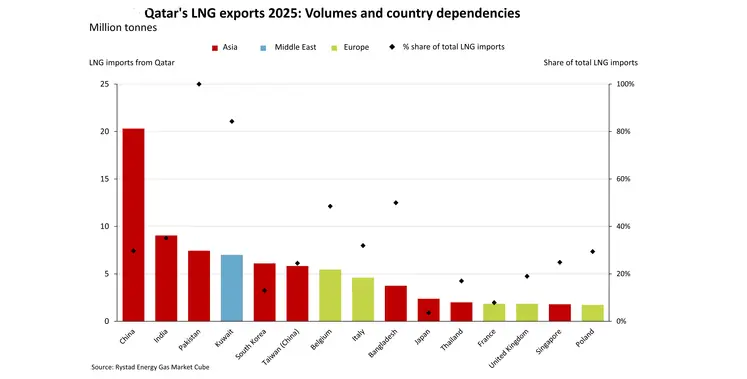
Qatar's LNG exports. (Image source: Rystad Energy)