In oil & gas facilities, maintaining continuous production while protecting personnel is a constant priority. Many process vessels operate under pressure and contain toxic, corrosive or flammable media, which makes instrument maintenance complex and potentially hazardous. Shutting down a process to service a single field instrument means lost production, higher costs and extended downtime
Process isolation addresses this. A shut-off device, such as a ball or gate valve, is installed between the process connection and the instrument. Sensors can then be removed, inspected or replaced without exposure to the process, which protects maintenance personnel and improves plant availability.
The challenge: radar above an isolation valve
A full-port ball valve may appear to offer a clear path for the radar signal. In practice, its internal geometry, sealing surfaces, flange interfaces and diameter transitions all reflect the signal. These surfaces generate false echoes before the signal reaches the product.
These effects get stronger in several situations: when measuring low-dielectric hydrocarbons or liquefied gases, under vapour-rich conditions, or where stilling pipes and multiple flanges sit between the antenna and the process. If the medium reflects weakly, installation echoes can mask the true level signal, particularly near the top of the vessel.
Engineering the installation
VEGA has years of experience in hazardous and corrosive applications. Drawing on it, VEGA developed an installation arrangement that combines safe process isolation with optimum radar performance. The valve is not treated as an unavoidable source of interference. Instead, the complete geometry of nozzle, valve and connecting sections is optimised to preserve the radar signal. The solution is built around VEGAPULS 6X, with its narrow 3° beam angle and 120 dB dynamic range.
Why beam angle matters
The wider the beam, the more energy strikes internal hardware instead of reaching the product surface. In the evaluated installation, an 8° beam spread to about 100 mm after just 700 mm of travel. It hit the valve body, reducers and pipe walls, even in a 4-inch connection. A 3° beam stayed concentrated at about 37 mm over the same distance and passed cleanly through the isolation assembly. The result is fewer installation reflections and more usable energy at the product surface.
Why dynamic range matters
Many hydrocarbons and liquefied gases have low dielectric constants and naturally reflect little radar energy. Vapours, condensation and foam weaken the echo further. Dynamic range defines the weakest echo a sensor can reliably detect. With 120 dB, VEGAPULS 6X can detect echoes up to 1,000 times weaker than a 90 dB sensor can. This lets it separate genuine level signals from installation reflections where other sensors may struggle.
Benefits for operators
- Safe process isolation without compromising measurement performance
• Reduced risk of false readings from installation reflections
• Reliable measurement of low-dielectric hydrocarbons and liquefied gases
• Simpler maintenance and improved availability
• Greater confidence in level measurement for pressurised vesselsEngineering recommendation
A narrow beam alone cannot overcome every installation challenge, and neither can high dynamic range alone. The combination of the two is what works. When isolation is required, treat the installation as an integrated measurement system, not simply a valve added beneath the transmitter. Best practice includes:
• Selecting a full-bore ball valve wherever possible
• Keeping the internal bore as large and continuous as practical
• Minimizing diameter transitions and unnecessary flanges
• Using a radar sensor with a narrow beam angle and high dynamic rangeWith the right mechanical arrangement and advanced radar technology, safe process isolation and reliable level measurement can be achieved together, even with hazardous, corrosive or low-reflectivity media.
Reliable radar level measurement in hazardous oil & gas applications
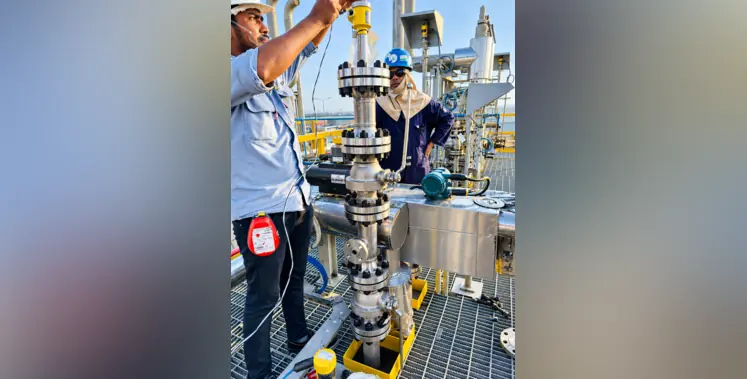
Technicians servicing stainless steel valve assembly. (Image source: VEGA)