








Across the Middle East, oil and gas operators are acquiring larger, denser and more complex seismic datasets to unlock increasingly subtle geological targets
But as data volumes grow into the hundreds of billions of traces, the real challenge is no longer just acquisition. It is how quickly and confidently those datasets can be turned into actionable insight.
When growing data volumes are coupled with modern processing and imaging algorithms, such as elastic multi-parameter full waveform inversion, and the continued rise of artificial intelligence (AI) based workflows, the result is that high performance computing (HPC) systems are being pushed harder than ever. This of course intensifies demands on power, cooling and scalability. For energy giants, a key challenge is ensuring their HPC infrastructure remains fit-for-purpose to keep pace with modern geoscience.
Global technology company DUG is known for its state-of-the-art software and its network of some of the largest supercomputers on Earth. Against a constantly evolving hardware landscape, the Australian-born company is keeping its edge with the deployment of 82 new NVIDIA H200 machines, adding 41 petaflops of compute power to its global data-centre capacity. Each machine delivers an order-of-magnitude performance uplift over DUG’s fastest CPU-only hardware, further reducing the company’s turnaround times across both testing and production workflows.
The operational realities of a modern HPC facility also present significant opportunities for reducing both cost and environmental footprint. One way that DUG has maximised the energy efficiency of its HPC ecosystem is through the use of immersion cooling – where servers are submerged directly into a fluid that removes heat far more effectively than air. The technology supports significantly higher compute density, reduces power consumption and creates a stable environment without hot spots, dust or oxidation. Immersion allows operation at higher temperatures compared to air-cooling, thereby also reducing reliance on evaporative cooling, allowing hybrid or dry-cooling configurations that lower water use. This ultimately makes efficiency and sustainability part of the same design.
“Our data-centre upgrade significantly increases our total compute power,” said Harry McHugh, chief information officer at DUG. “This translates to even faster delivery of huge datasets and more computationally intensive workloads, from AI-inference applications, to advanced seismic processing and imaging workflows, including our revolutionary DUG Elastic MP-FWI Imaging technology”,
“Designing and operating at this scale gives us intimate knowledge of what modern HPC demands in practice – and this expertise drives the solutions we build and operate for our clients.”
With its new Abu Dhabi office supporting large-scale projects across the region, and a technology stack built around energy-efficient HPC and advanced imaging algorithms, DUG is primed to power the next wave of discovery in the Middle East, delivering faster, clearer and more reliable subsurface insights.
Powering the next wave of seismic insights
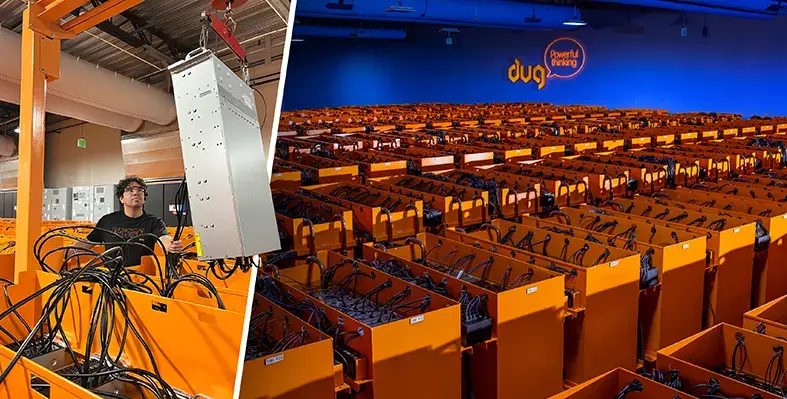
DUG is primed to power the next wave of discovery in the Middle East. (Image source: DUG)