IFS, a leading provider of Industrial AI software, has launched IFS Intelligence, which collates data from assets, systems and processes throughout an industrial operation and turns it into meaningful action in minutes
Built around everything the operation already knows – its assets, work orders, schedules and history – IFS Intelligence understands how that operation runs, bringing Industrial AI to the point of work: people in the field, on the plant floor, on a rig or in the office can ask questions in plain language through a single conversational interface. IFS Intelligence reasons across live operational data to explain what is happening and plan what should happen next, with the sources shown. It can then act on that plan, governed by IFS’s Industrial AI Harness, and within the limits set by the business.
Customers are already using IFS Intelligence across a number of business-critical scenarios. One recent use case was experienced by a production manager who learned that a large order due next quarter was at risk. Finding out why, and what to do about it, meant connecting inventory, production capacity, supplier commitments, logistics constraints and the financial impact of delay. With IFS Intelligence, one question can identify the risk, surface likely causes and recommend the next action, which the manager can approve and set in motion. What used to take several reports, systems and specialists, or might not have even been possible, becomes one governed flow from question to action.
IFS Intelligence harnesses Industrial AI in three ways:
- Ask and act with Cowork: question live operational data in plain language, investigate problems and prepare actions that run only once a person provides approval. Any answer can become a Lens, a live view that keeps updating as the operation moves, and work that succeeds once can be saved as a Skill for anyone to repeat.
- Delegate with Loops: hand defined workflows to digital workers that run in the background and escalate when judgment or approval is needed.
- Extend with Runway: use plain-language requirements to speed up the migration, configuration and extension of IFS, with less implementation effort and less risk.
Underneath all three, the IFS Industrial AI Harness applies the context and controls that industrial operations require.
Mark Moffat, CEO, IFS, commented, “We often see industrial organisations operating at around 60% of their potential. The missing 40% is already inside the business. It sits in the expertise of the control room, the knowledge of the night shift, and the data spread across every system. IFS Intelligence brings all of it together and puts it to work. People can ask a question, take action, or hand a task to a digital worker, all within the rules, permissions and approvals that govern their business. That is how industry closes the gap.”
The era of limitless industry
IFS Intelligence was launched at IFS Unleashed, the company's flagship industrial AI event which took place in Orlando, USA, and brought together innovators and visionaries from the world’s leading Industrial businesses to redefine what AI-connected intelligence can achieve. With the tagline "The era of limitless industry", Unleashed 2026 showcased how AI-driven insights and agentic automation can combine to unlock new levels of industrial productivity.
Delegates got a glimpse of the workplace of the future, with human potential augmented with industrial AI, digital workers, robotic workers, AI with abilities in the physical world and the transition of core systems from systems of record to systems that learn and compound knowledge. All this enables products to be developed faster and observed in use, with the resulting insights taken into learning and leading to better products and services.
Giving the introductory keynote address at the event, Mark Moffat introduced the theme of unleashing potential of people and assets through AI and super intelligence, identifying a “generational opportunity” for industrial sectors to lead a new technological revolution at a time of unprecedented volatility, with extreme pressures on energy demand, supply chain disruption and rising operating costs.
“That puts massive pressure not just on the energy companies and the utility companies but all of industry – the knock-on impacts are huge.”
“That is the new reality we’re all operating in.”
IFS aims to use industrial AI to provide frontline workers with “superpowers” to capture lost potential caused by factors such as skills shortages, ageing infrastructure, out of date processes and inaccessible data.
“The average worker spends about a third of their time with an actual tool in their hand. The rest is spent waiting, searching, or filling in forms,” Moffat said.
“If we deploy AI on some simple use cases, we can save that linesman 15 minutes five times a day filling in a laborious form through the use of AI. Picture some of those examples across every business in this room, the 40% that has never been realised, and we have the tools to unlock it now. That’s what we’re focused on.”
Moffat explained how IFS’s approach is to build industrial AI through an ecosystem, working together with “the companies building the next frontier of intelligence, the robotics, leaders, the hyperscalers, and all of the industry specialists we work with, with IFS at the centre turning that possibility into day-to day operations,” highlighting its partnerships with companies such as Microsoft, Anthropic and Siemens.
Moffat outlined how IFS had disrupted itself to get back into the workforce and day-today operations to ensure its software is built for an AI-driven future, establishing the Nexus Black team to develop leading edge technologies directly within industrial environments, from aircraft hangars to distilleries and manufacturing plants. The approach focuses on using industrial AI to solve real-world problems fast to deliver tangible ROI and real outcomes for frontline workers.
“It’s AI for the industries the world relies on, and it’s built with the workers who run them,” he said.
IFS launches IFS Intelligence to address industrial challenges
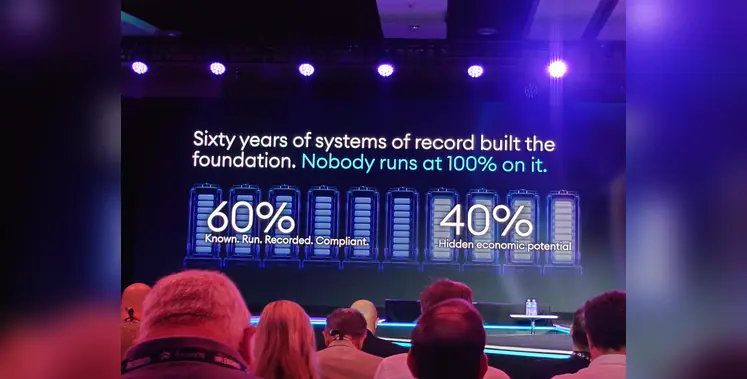
IFS aims to unlock the hidden 40% economic potential. (Image source: Alain Charles Publishing)