









A new report from AVEVA, a global leader in industrial software, and the International Institute for Management Development (IMD) discusses what makes digital ecosystems succeedBased on a global survey of 275 senior business leaders across 12 industry sectors and 19 expert interviews, the inaugural Industrial intelligence Report on Digital Ecosystems and the Future of Connected Industries explores how organisations can harness their industrial intelligence to build, orchestrate and scale business ecosystems that create value, and highlights the main barriers to success.
Increasingly, organisations are seeking to construct digital ecosystems to address business challenges, whether that is innovating faster, navigating supply volatility, or decarbonising complex global operations. Such ecosystems – networks of independent but interdependent organisations that interact through shared digital infrastructure, shared data and co-ordinated decision making – create value that no single organisation could produce alone. Digital ecosystems are delivering measurable operational value in areas such as customer experience, commercialisation speed and ecosystem-wide automation.
Yet, as the research shows, the gap between digital ecosystem ambition and execution remains wide. Where ecosystems are working, companies are realising tangible value through harnessing their industrial intelligence. But the barriers to success remain challenging, spanning the areas of corporate strategy, governance, and technology.
In a fireside chat at AVEVA World in Milan, where the report was launched, AVEVA CEO, Caspar Herzberg spoke about the findings with Michael Wade, director of IMD Global Center for Digital and AI Transformation and Professor of Strategy and Digital, IMD.
Importance of data sharing and good governance
Professor Wade highlighted that the two key factors posing challenges were data sharing and governance, both of which are critical for value to be created, delivered and captured.
While 74% of leaders surveyed consider digital ecosystems a top strategic priority, only 27% report sharing data substantially or extensively with ecosystem partners, and only 9% have achieved joint, integrated cross-organisation data governance.
“The more data was shared, the more value was created, but at the but at the same time, paradoxically, we saw a quite a large reluctance to share data,” Professor Wade said.
Discussing the importance of setting up good governance, he commented, “Poor governance or lack of governance reduces value. Those organisations that had set up strong joint governance celebrated value in their digital ecosystems.” Governance maturity is strongly associated with ecosystem value, the report shows.
Ai is widespread but shallow, according to the findings, with only 3% treating it as a core platform capability. Infrastructure constraints, rather than trust or regulation, represent the main barrier to AI deployment in ecosystems.
Several illustrative case studies also emphasise the gap between ambition and execution: integration complexity, legacy systems and weak governance. Most organisations are investing in digital ecosystem strategy while underinvesting in the operational foundations that make ecosystems work.
The report concludes that organisations most likely to lead the next phase of digital ecosystem development will be those that solve the fundamental problems that currently prevent ecosystems from delivering on their promise: governance structures aligned across partners, deeper data sharing and the capability to collaborate broadly across diverse partner types.
Herzberg explained, “With this collaboration with IMD, our ambition is not merely to understand the motivations behind the move to digital ecosystems, but to define the frameworks, competencies and leadership practices that will concretely enable companies to transcend silos and build more adaptive, ecosystem driven operating models.”
“Governance, integration and learning matter more right now than algorithms. Ecosystems are already delivering operational value. The next phase is about converting that foundation into strategic advantage through better data sharing, coordination, clearer roles and more deliberate leadership... Industrial sectors have decades of experience collaborating out of operational necessity. What is changing is that data, AI and connected platforms are turning those collaborations into real time, intelligence driven systems,” commented Professor Wade.
AVEVA/IMD report highlights factors for successful digital ecosystems
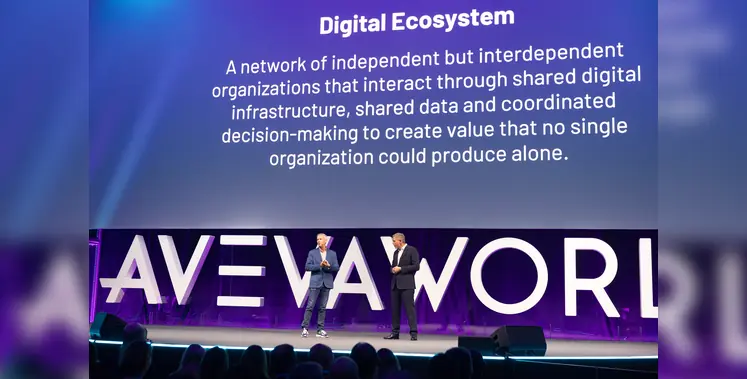
Professor Michael Wade and Caspar Herzberg, CEO of AVEVA discuss the report findings at AVEVA World 2026. (Image source: Alain Charles Publishing)