









With major mining investments underway across the region, the demand for efficient and robust material transport is growing. Long-distance conveyors play a key role in reducing reliance on truck haulage and improving operational performance in challenging environments
As major mining investments gain momentum across the Middle East, operators are increasingly focused on how to move large volumes of material efficiently across vast and often remote project sites.
In this context, material transport is no longer seen as a secondary consideration, but as a strategic component of overall mine design. Long-distance conveying systems are emerging as a compelling alternative to traditional truck haulage, offering a scalable and energy-conscious solution that supports both operational performance and the region’s growing emphasis on efficiency and infrastructure development.
Large-scale mining projects today are defined by greater distances, higher throughputs and more complex site conditions. From high-altitude operations to desert environments with extreme temperatures and dust exposure, material handling infrastructure must deliver consistent performance under demanding conditions. Conveyor systems, particularly overland and in-pit crushing and conveying (IPCC) solutions, are increasingly being engineered to meet these challenges as integrated components of the overall mine design.
One of the key advantages of conveying lies in its ability to provide continuous, electrified transport. Compared with truck haulage, conveyors can significantly reduce fuel consumption, operating costs and associated emissions, particularly over long distances and high volumes. This makes them an attractive option for mining regions investing in new infrastructure and seeking to improve the sustainability of their operations.
As conveying distances and installed power increase, however, the performance of the drive system becomes a critical factor. Conventional drive arrangements, typically based on high-speed motors and gearboxes, can approach their technical and practical limits in large-scale applications. This has led to growing interest in gearless drive technology, which replaces the traditional drivetrain with a slow-running synchronous motor directly coupled to the conveyor pulley.
By eliminating the gearbox, gearless drives simplify the mechanical system and reduce the number of wear components. This results in lower maintenance requirements, improved reliability and reduced downtime — particularly valuable in remote or difficult-to-access locations. In addition, the absence of gearbox losses and the high efficiency of synchronous motors contribute to improved overall energy performance, especially under partial load conditions where conveyors typically operate.
Modern gearless drive systems are also closely integrated with digital control platforms, enabling precise control of conveyor speed, optimised load sharing and advanced condition monitoring. These capabilities support predictive maintenance strategies and help operators maintain consistent performance across the entire material handling chain.
From a system perspective, advances in conveyor design are equally important. The use of horizontal curves, for example, allows conveyors to follow natural terrain and reduces the need for multiple transfer points, improving system availability and lowering maintenance requirements. Fully enclosed conveying solutions such as pipe conveyors can further support environmental performance by minimising dust emissions and material spillage.
While gearless drives are not required for every application, their value becomes clear in high-capacity, long-distance and high-lift scenarios where reliability, efficiency and lifecycle cost are critical. In these cases, a project-specific evaluation often shows that reduced operating expenditure and improved system availability can offset higher initial investment.
As mining development continues to accelerate across the Middle East, the need for efficient, reliable and future-ready material transport solutions will only grow. In this evolving landscape, conveying systems—supported by advanced drive technologies — are increasingly being recognised as a strategic enabler of large-scale project success. By reducing reliance on conventional haulage and aligning with broader goals around efficiency and infrastructure optimisation, they offer a practical pathway for operators looking to build resilient operations that can meet the demands of both today’s projects and those still to come.
For more information on TAKRAF Group’s conveying systems capabilities, visit www.takraf.com
Supporting mining in the Middle East with advanced conveying solutions
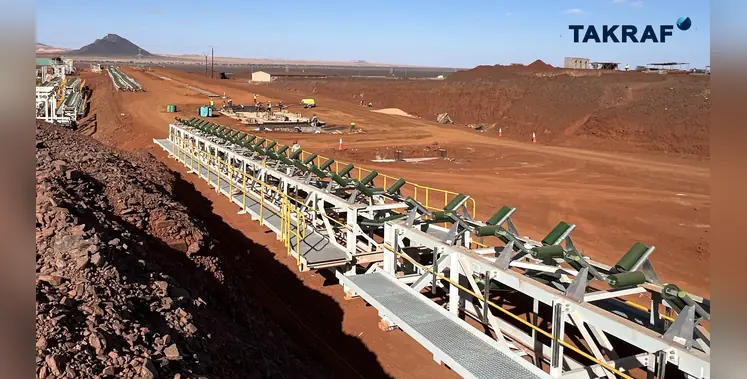
Assembly of a TAKRAF conveying system at F’Derick iron ore project, Mauritania.