









Oil prices have risen again following reported attacks on vessels transiting the Strait of Hormuz which prompted the USA to launch renewed airstrikes on more than 80 targets in Iran and President Trump to declare the ceasefire over
The US also revoked the sanctions waiver that had allowed limited Iranian oil exports, while missile and drone attacks on military bases in Bahrain and Kuwait have been reported.
Brent crude reached US$78-79/bbl, up more than 5%, reflecting the risk of renewed disruption to oil supply through the Strait. The move highlights how sensitive prices remain to any escalation around the Strait, given its role as a critical transit route for global oil flows, comments Rystad Energy, adding that even if no sustained physical disruption materialises, uncertainty around vessel safety, insurance costs, potential delays, and the risk of further retaliation is likely to keep volatility elevated in the near term.
“The events of the last few days significantly weaken any confidence that the current 60-day truce can still evolve into a permanent peace agreement,” said the energy consultancy.
“Vessel movements have already fallen sharply, and traffic through the Strait will almost certainly remain reduced until the security situation becomes clearer and market participants gain more visibility on whether a diplomatic off-ramp remains available.”
Prior to these events, oil prices had dropped to the lowest level since hostilities began, with Gulf producers ramping up production and exports following the ceasefire agreement and OPEC + countries agreeing an increased production quota for August, leading to the prospect of a well-supplied or even an oversupplied market later in the year. Gulf oil exports in June jumped more than 3 million barrels from May to more than 10 million barrels per day, according to Reuters, although volume remained 40% below pre-war levels.
Seven OPEC+ countries agreed a further increase in output targets from August, increasing quotas by 188,000 bpd for the fifth consecutive month in continuation of the unwinding of production cuts agreed in 2023.
Jorge Leon, head of Geopolitical Analysis at Rystad Energy said, “Tanker traffic through the Strait of Hormuz has essentially stopped, which tells you more about risk perception right now than any statement from Washington or Tehran.
Brent's climb to its highest level since 19 June shows how quickly the market is pricing in a ceasefire the US president himself says is over.
The real test comes after 9 July, once the mourning period ends and both sides show whether there is still an appetite for a diplomatic off-ramp.”
“Going forward, the latest developments are likely to restore part of the geopolitical premium that had largely unwound in recent weeks, although the broader outlook will depend on whether the conflict escalates further or diplomatic efforts resume,” commented MUFG research.
Samer Hasn, senior market analyst at XS.com said, “The return of rising oil prices comes as the market once again recognises the fragility of the current ceasefire and that the war in the Middle East has not ended, while the risks of oil supply disruptions remain high and the diplomatic path to settlement is still very long.
No breakthrough on the Strait
He added that he failure to achieve a breakthrough regarding the Strait means that the possibility of reaching an agreement on the most vital points, which relate to the Iranian nuclear program, will be much harder.
“Amid this narrative and the absence of a near-term outlook for a comprehensive diplomatic settlement, the risks of a return to the total closure of the Strait, or even the retargeting of vital energy facilities across the region, whether on the Iranian or Gulf side, remain high. This threatens a sudden spike in oil prices. Furthermore, this narrative will keep the OPEC+ decision to increase oil production on paper and unenforceable for now; in this case, the market will remain in a state of supply deficit, keeping prices vulnerable to rise.
“On the other hand, it is not unlikely that we could witness a sudden breakthrough regarding the return of ships and oil tankers crossing the Strait, or even the lifting of restrictions again on Iranian oil exports. This is for a single reason: the United States and President Donald Trump do not have enough time to engage in this war for long, with the midterm elections approaching and the average price of a gallon of gasoline remaining near US$4 per gallon. In this scenario, an OPEC+ hike might prove effective over time, lowering prices more quickly.”
Oil prices spike again on renewed US/Iran hostilities
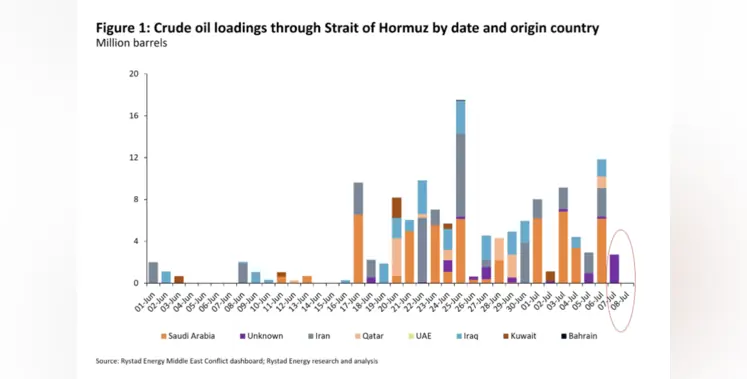
Image source: Rystad Energy