







Oil and gas prices have risen sharply on 19 March following renewed attacks by Iran on Gulf energy infrastructure
They followed Israel’s strike on Iran’s giant South Pars gas field, which marked a major escalation of the conflict.
Iran retaliated by issuing an evacuation warning identifying Saudi Arabia’s SAMREF refinery and Jubail petrochemical complex, the UAE’s al-Hosn gas field and Qatar’s Mesaieed petrochemical complex and Ras Laffan refinery as targets.
On 18 March, QatarEnergy said Iranian missile attacks on Ras Laffan, the site of Qatar’s main LNG processing operations, caused extensive damage to the Pearl GTL (Gas-to-Liquids) facility. On 19 March the company confirmed that in the early hours, several of its LNG facilities were the subject of missile attacks, causing sizeable fires and extensive further damage. Emergency response teams were deployed immediately to contain the resulting damage with no reported casualties. Qatar had earlier in March halted liquefaction operations after its Ras Laffan facilities were hit by an Iranian drone.
QatarEnergy CEO Saad al-Kaabi told Reuters that the damage caused by Iran’s attack on its facilities has wiped out 17% of their operating capacity and would cost around US$26bn to repair. As a result, the company may need to declare force majeure on long-term contracts for natural gas supplies with Italy, Belgium, Korea and China for up to five years. QatarEnergy had earlier in the month declared force majeur on LNG production after the earlier attacks on Ras Laffan.
The UAE is reported to have stopped operations at its Habshan gas facility and Bab field after intercepting a drone attack, while Kuwait’s Mina Al Ahmadi and Mina Abdullah refineries were hit by a drone, triggering fires, which were successfully extinguished without any injuries, according to a statement from Kuwait Petroleum Corporation (KPC).
While Reuters reported on 19 March that Aramco’s SAMREF refinery, a joint venture between Aramco and ExxonMobil in the Red Sea port of Yanbu, was targeted but with minimal impact. Yanbu has become a key alternative export route for crude oil via the East-West pipeline, with the effective closure of the Strait of Hormuz.
Attacks on Gulf energy facilities prompted US President Trump to threaten to “massively blow up” the South Pars field if Iran continues to target Qatar’s LNG facilities.
Oil and European natural gas prices rose sharply on 19 March with Brent crude up 6% to US$114, the highest level since the spike at the beginning of the conflict, while European gas prices rose by 25-30% to double pre-conflict levels, reflecting supply concerns given Qatar accounts for around 20% of seaborne LNG trade.
Matthieu Favas, commodity editor at the Economist, commented on the BBC’s Today programme that the hope would be that Qatar's gas facility is "restarted within weeks", but after several direct attacks this is unlikely to happen. He added that the summer months could see competition for LNG supplies, with increased demand from countries needing power for air conditioning and European and Asian countries looking to restock.
Energy consultancy Rystad Energy notes that the five facilities targeted by Iran collectively account for around 20% of global LNG trade, up to 10% of Asia-Pacific naphtha imports and more than 6% of global polyethylene capacity, concentrated in a geography with no short-term substitute. With facilities in Saudi Arabia, UAE and Qatar all hit at least 700,000 barrels per day of refined product capacity could be removed from global markets overnight, hitting diesel, jet fuel and naphtha supply simultaneously across three countries.
“The breadth of what is at risk here in fuels, chemicals, LNG and fertiliser inputs is what makes this moment qualitatively different from previous episodes of Gulf tension,” the energy consultancy comments.
"Qatar is particularly exposed given the concentration of its LNG infrastructure at Ras Laffan, which is closely tied to the broader North Field, the extension of Iran's South Pars gas field. Any disruption here would not only affect regional supply but ripple through global LNG markets, with Asia bearing the brunt given its dependence on Qatari volumes," commented Aditya Saraswat, senior vice president at Rystad Energy.
Gulf ministers and governments have decried the attacks on their critical energy and civiian infrastructure. In an impassioned LinkedIn post, Dr Sultan Al Jaber, UAE Minister of Industry and Advanced Technology, said "These are civilian facilities, operated by civilian engineers, sustaining economies and everyday life far beyond our region. This is an unjustified, unprovoked and illegal attack on a peaceful nation. But it is not just a regional issue - it is global economic warfare. Energy flows are being weaponised."
Oil and gas prices soar with escalation of Middle East conflict
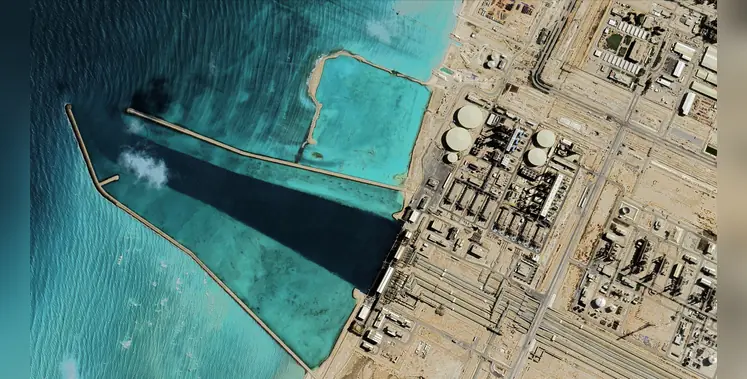
Qatar's Ras Laffan facilities have come under attack. (Image source: Adobe Stock)