








Oil and gas employment expanded globally in 2024, driven by LNG project developments, and the Middle East remains the centre of world oil and gas employment, according to the IEA’s newly-released World Energy Employment 2025 report
Oil and gas supply has recovered most of the jobs lost in 2020, as global production capacity continues to expand. However, a number of major oil companies announced job cuts in 2025, in the face of lower oil prices and revenues.
Oil and gas production and distribution employed 12.4 million people in 2024, up 210,000 y-o-y, according to the report. Around two-thirds were employed in oil with the remainder in natural gas. Natural gas employment was boosted by new LNG facilities and associated manufacturing of related equipment. Oil and gas jobs slightly decreased in advanced economies, with growth now almost exclusively concentrated in emerging markets and developing economies (EMDEs).
The Middle East remains the centre of oil and gas employment, accounting for more than 20% of the sector’s global workforce. Oil and gas jobs represent two-thirds of total energy employment in the region, compared to a global average of just 16%, highlighting the sector’s dominant role in the regional economy and labour market. In 2024, Middle Eastern companies increased their oil and gas capital investments by 10%, creating around 83,000 new jobs. Countries in the region have invested heavily in the training and development of their national oil and gas workforces.
LNG remains the driving force behind natural gas employment growth. Worldwide investments in the sector increased by 11% since 2023, led by North America and the Middle East, which together made up two-fifths of total spending.
Oil and gas companies are adopting a range of strategies to manage uncertainty surrounding the sector’s long-term outlook. Some IOCs are increasingly shifting funds toward improving the production rates of existing fields with automation, improved drilling techniques and artificial intelligence to reduce the labour intensity of their operations. At the same time, IOCs are also investing in clean energy and reallocating resources to diversify and attract young talent.
Addressing skills gaps
The report warns of skills shortages and gaps, with applied technical roles such as electricians, pipefitters, line workers and plant operators in short supply. An ageing workforce is compounding the problem. At the same time, the supply of newly qualified workers is not keeping pace with the sector’s needs. To prevent the skills gap from widening further by 2030, the number of new qualified entrants into the energy sector globally would need to rise by 40% requiring an additional US$2.6 billion per year of investment globally, according to the IEA.
Targeted retraining and reskilling could help workers transfer from fossil fuel employment into other parts of the energy system that are growing, with 50% of fossil fuel workers said they would prioritise staying within the energy sector if seeking alternative employment.
The report notes that energy firms lag other sectors in artificial intelligence capabilities, with concentrations of AI-skilled workers about 40% lower than in technology, finance, education, and media. And while investment in AI skills and capabilities is rising in the energy sector, current use cases do not significantly reduce demand for applied technical workers in construction, operations, and maintenance, which are mostly manual roles dominated by tasks that AI is not currently well suited to replace.
“Energy has been one of the strongest and most consistent engines of job creation in the global economy during a period marked by significant uncertainties,” said IEA executive director Fatih Birol. “But this momentum cannot be taken for granted. The world’s ability to build the energy infrastructure it needs depends on having enough skilled workers in place. Governments, industry and training institutions must come together to close the labour and skills gap. Left unaddressed, these shortages could slow progress, raise costs and weaken energy security.”
Oil and gas employment continues to rise
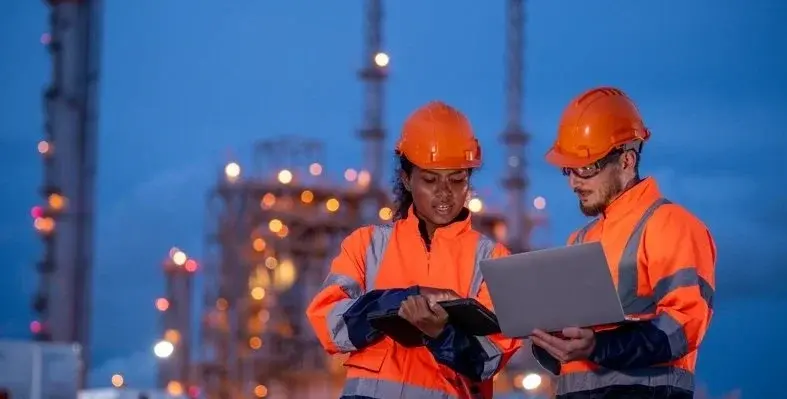
Oil and gas employment expanded in 2024. (Image source: Adobe Stock)