









Oil and gas industry network Subsea Wireless Group (SWiG) has released a new industry specification for free-space optical communications, providing a common protocol for modems from different manufacturers
SWiGoptical Level 1 defines a simple protocol to satisfy interoperability and interchangeability requirements for subsea free-space optical communication devices. It supports applications including, but not limited to, process control, equipment and process monitoring, diagnostics and maintenance, and data exchange and harvesting across autonomous underwater vehicles (AUVs) and other connected subsea systems.
Systems working together
SWiG, a joint industry project (JIP) managed by OTM Networks (part of R&D consultancy Sagentia Innovation), was established to enable vehicles, infrastructure and equipment from different suppliers to work together seamlessly. It has 27 members representing all parts of the supply chain, from major energy operators to subsea service providers and integrators to specialist instrumentation companies. Its objectives include:
• Promote interoperability between users of subsea wireless communications.
• Raise industry awareness and acceptance of subsea wireless communications.
• Identify areas (within subsea wireless communications) where open standards are needed, and develop them.
• Encourage the integration of subsea wireless communication technologies.
• Share best practices across the industry.
• Promote knowledge transfer across the industry.Shreekant Mehta, senior vice president, Energy Sector at Sagentia Innovation, said SWiGoptical Level 1 represents an important step towards optical modem interoperability for subsea systems.
“SWiG’s goal is to create a common subsea ecosystem where devices from different manufacturers interact seamlessly,” Mehta explained. “As subsea communication technologies continue to mature, a collaborative approach to developing open standards supports cost management and provides a common framework, reducing deployment risk, simplifying integration and supporting scalability. Achieving interoperability across subsea operations is essential if the industry is to realise the full benefits of autonomy.”
The new specification builds on the earlier SWiGacoustic standard and is the latest in a family of complementary SWiG standards that also cover radio frequency (RF), inductive data and power and hybrid communications. SWiGoptical Level 1 is now available to the wider industry, with Level 2 and Level 3 specifications for higher-performance protocols already under development.
New standard promotes interoperability in subsea communications
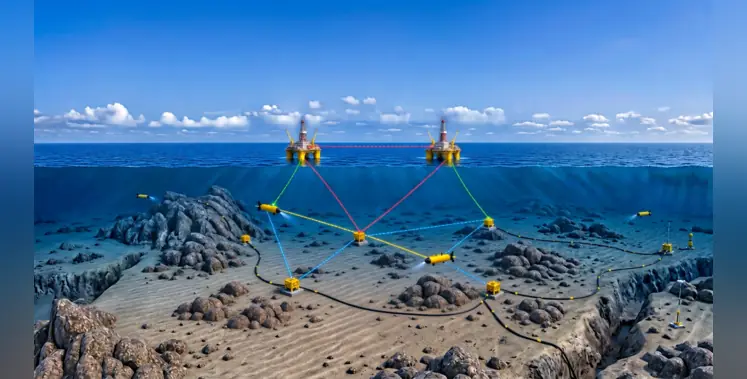
The new standard represents an important step towards optical modem interoperability for subsea systems. (Image source: SWiG)