








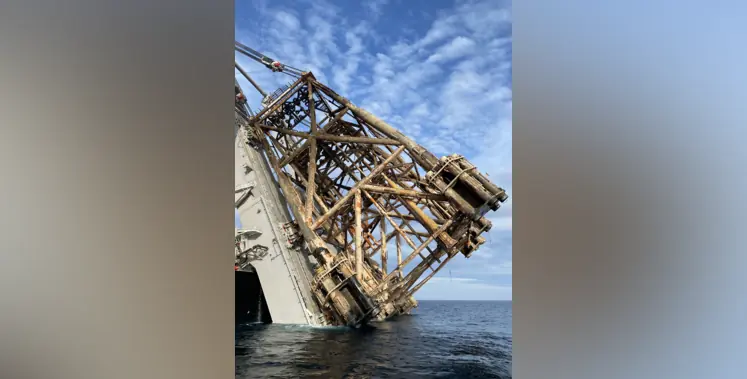
The offshore energy sector is currently facing a monumental transitional phase as thousands of legacy structures reach the end of their operational lifecycle.
In response to this escalating industry challenge, Aquaterra Energy, a leading provider of intelligently-engineered products and services for well access and offshore developments, has formally aligned with James Fisher and Sons plc (James Fisher). James Fisher, a renowned global provider of specialist marine and energy solutions driving offshore energy forward, joins Aquaterra Energy to form a new strategic global partnership. This vital collaboration is explicitly designed to streamline offshore decommissioning delivery, presenting a cohesive solution to an increasingly complex operational landscape.
An Integrated Delivery Model
By joining forces, the two organisations aim to provide energy operators with a single, highly integrated route to meticulously plan and execute well abandonment and infrastructure removal programmes. Under this newly established partnership model, the division of expertise is clearly delineated to maximise operational efficiency. Aquaterra Energy is taking the lead on all front-end engineering and well access solutions. Concurrently, James Fisher, operating through its dedicated energy division, is responsible for delivering comprehensive subsea operations alongside offshore execution expertise.
Together, these two industry leaders offer a significantly more coordinated alternative to highly fragmented traditional decommissioning models. Their approach actively connects early-stage planning, detailed engineering, and well access with final offshore execution under a much clearer, unified delivery framework. For operators, this directly translates to fewer handovers between disparate contractors, substantially stronger accountability throughout the project lifecycle, and far greater certainty from initial scope development through to final execution. Importantly, this unified approach still retains the vital flexibility required to adapt seamlessly as specific project requirements inevitably evolve.
Addressing a Massive Global Requirement
The strategic collaboration is set to operate on a truly global scale. The initial operational focus will be heavily directed towards the North Sea, the Asia-Pacific (APAC) region, and the Middle East. These specific regions represent critical markets where a highly significant number of offshore wells and existing infrastructure are currently approaching the stage of permanent abandonment.
The sheer scale of the upcoming decommissioning workload is immense. In the UK Continental Shelf alone, recent reports from the North Sea Transition Authority highlight that there are currently 153 wells sitting past their decommissioning consent deadlines. Furthermore, an estimated £44 billion is still projected to be spent on regional decommissioning efforts. The situation is similarly pressing in Australia, where detailed government modelling estimates that offshore decommissioning liabilities could reach a staggering £48 billion over the course of the next thirty to fifty years. Looking at the global picture, it is anticipated that more than 2,500 offshore structures will ultimately require complete decommissioning by the year 2040. This rapidly growing international workload is the primary catalyst driving the urgent industry demand for much more efficient delivery models.
Leadership Perspectives
Matt Marcantonio, Head of Engineering at Aquaterra Energy, said: “Decommissioning programmes are increasingly moving away from simple, isolated scopes. The next generation of projects will require tight engineering control, early integration and the ability to adapt quickly as conditions change. By aligning our expertise with James Fisher from the outset, we can shape more efficient scopes, prevent downstream redesign and ultimately reduce offshore duration. We see this as a way to give operators the confidence to take on decommissioning programmes that are becoming more technically demanding and commercially pressured, while keeping the agility needed to respond as projects evolve.”
Mark Stephen, Product Line Director - Decommissioning & CFE at James Fisher Energy, commented: “What operators are looking for now is delivery confidence, predictable execution, fewer interfaces and teams who already understand how to work together. By combining our subsea operations capability with Aquaterra Energy’s early engineering and well access expertise, we can remove many of the common friction points that slow projects down offshore. This model gives operators a scalable, field-proven approach that directly supports safer, more efficient execution as global decommissioning activity accelerates.”
Operational Execution and Safety
Moving forward, the partnership will operate strictly on a project-by-project basis. The precise team composition for each undertaking will be meticulously determined by the specific scope of work required. This tailored approach will include the strategic utilisation of cross-trained crews. Doing so will significantly reduce the number of people offshore (POB), which subsequently lowers the overall exposure to operational risk. While operating within this agreed collaborative framework to ensure aligned delivery, each company firmly remains an independent entity. Both partners are already actively engaging with operators regarding upcoming decommissioning opportunities across multiple international regions.
Aquaterra and James Fisher form global decommissioning partnership
Aquaterra Energy, a leading provider of intelligently-engineered products and services for well access and offshore developments, has formally aligned with James Fisher and Sons plc (James Fisher). James Fisher, a renowned global provider of specialist marine and energy solutions driving offshore energy forward, joins Aquaterra Energy to form a new strategic global partnership.