








Ampelmann discusses the changing offshore access strategies in the Middle East
Helicopters, crew boats, jack-ups. Vessels equipped with ropes, baskets or motion compensated gangways. Offshore activity across the Gulf of Arabia, the Caspian and Arabian Sea spans field development, maintenance and decommissioning, all dependent on getting personnel and cargo efficiently and safely to and from their worksite. From low cost but inconsistent, to reliable but OPEX-straining, these days there is a mix of different offshore access methods used across the Middle East.
Increasingly, motion compensated gangways are entering that mix, closing the gap between the consistency offered by the heavier, costlier options without carrying the same exposure to hazardous and time-consuming marine conditions.
The value of Walk to Work
Sea conditions across the Middle East are often benign, but high waves, strong winds and seasonal weather like the Shamal can disrupt and delay operations. Walk to Work (W2W) – as transferring personnel and cargo with motion compensated gangways is commonly known – provides a stable pathway that ensures personnel can safely reach their offshore destinations in these conditions.
W2W systems are increasingly used throughout the Middle East because they also offer advantages beyond the weather. Since its first operations in Qatar in 2012, Ampelmann has transferred over three million crew members in over 75 projects for international and national oil companies in Qatar, Saudi Arabia, United Arab Emirates, Azerbaijan, Egypt and Oman.
By enabling quick and reliable personnel transfers to fixed and floating structures, the company’s gangway systems increase tool time and accelerate project delivery.
Trusted, proven, experienced
The value W2W brings is increasingly applied to established access strategies. While jack-up accommodation barges are a familiar sight across the Gulf, housing large crews to facilitate construction and maintenance work, W2W solutions are complementing this model. Accommodation vessels paired with an Ampelmann gangway system offer a flexible and cost-effective solution that can relocate quickly between offshore assets.
For routine crew transfer, W2W also offers a reliable alternative to helicopters and scales naturally with campaign length and crew sizes. Crew boats, both DP and non-DP, are a prevalent vessel class across the region, but are frequently equipped with baskets, ropes or simple gangways. Due to its compact size, Ampelmann’s fully electric L-type is ideal for smaller vessels, enabling safe and continuous access that maximises uptime and hands-on-tool time. Quick to mobilise and capable of connecting to an offshore platform within a minute, this tried and tested configuration already sees much use in the oil fields near Brunei and Malaysia.
Global presence, local support
Ampelmann’s extensive track record in the Middle East is underpinned by strong localised support. Local project managers, operators, maintenance technicians and engineers bring decades of combined regional experience, backed by storage facilities in Qatar and the UAE and a 24/7 global support network through the Operation Control Centre (OCC).
Together, this keeps projects running and response times short. It's this combination of proven technology and local presence that continues to deliver safe and efficient offshore access across the Middle East.
Walking to work - the growth of gangway systems
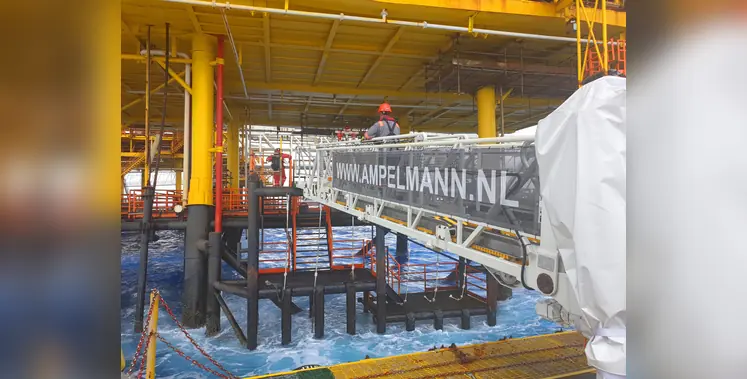
The Ampelmann L-type gangway. (Image source: Ampelmann)