







In an exclusive interview with Oil Review Middle East at ADIPEC, FLIR’s Stephen Beynon, OGI sales director discussed the use of FLIR’s optical gas imaging cameras in the oil and gas industry
Stephen Beynon began by explaining the importance of the role optical gas imaging (OGI) cameras play in regulatory compliance and environmental monitoring, given the tightening up of methane emissions regulations, net zero emissions agendas in the region and increasing stakeholder reporting requirements, explaining how OGI cameras visualise gas that cannot be seen or detected by the naked eye.
Stephen explained that it is “…very important from an environmental perspective, as we don’t want these harmful gases going into the atmosphere.”
He noted that while the US EPA and the EU methane regulations are mandatory, the Middle East region generally follows the Oil and Gas Methane Partnership (OGMP 2.0), a voluntary programme providing a framework for the identification and reporting of methane leaks, at different levels.
“Level 4 is where optical gas imaging comes in, focusing on the identification of leaks. What’s happening is an advancement of the technology so that we can now use gas imaging cameras to quantify leaks for regulatory reporting. OGMP level 5 is all about quantifying, measuring and reporting. So we are seeing quantitative optical gas imaging potentially being written into Level 5.”
He added that there an increasing demand from stakeholders in the region to meet the OGMP gold standard, a combination of Level 4 and Level 5.
Stephen Beynon pointed out that FLIR’s optical gas imaging cameras are used by major operators worldwide.
“A major UAE oil and gas operator for example have many of our cameras, and I’ve been speaking to their representatives to help them further deploy the technology for environmental reporting and regulatory requirements.
“So this is the main driver for optical gas imaging technology.”
Commenting on market prospects, Beynon went on to say that the main focus of the use of OGI technology in the oil and gas industry has until now been on production and processing, but interest is growing in the transmission side.
“I was just speaking to someone who is responsible for the transmission of gas to 18 different factories; this area of the industry can really benefit from OGI. Gas transmission can involve remote asset locations, such as block valve stations and compressor stations, and that’s where the evolution of optical gas imaging will come in, as we are now introducing a fixed mount optical gas imaging solution, which can be installed at remote sites to monitor assets and connect to the customer’s video monitoring system.”
He stressed that this is not designed to replace the traditional handheld OGI cameras, but to compliment it, providing an additional layer of security – which is particularly important for remote assets. He adds that studies are ongoing at the moment to gather the data and develop the deep learning to further refine the analytics and the AI to enable a fully autonomous fixed mount solution.
“That solution is called ADGiLE, and is available today,” he said. “We have a couple of installations at the moment that we are gathering data on. So this is going to be an evolving solution as we go forward.”
At ADIPEC, FLIR showcased the Gx320 and QL320 cameras, which visualise and quantify gas leaks in real time, helping industries meet environmental compliance and reduce emissions. Powered by Flir’s ADGiLE solution, users gain automated detection, geolocation, and reporting capabilities — streamlining inspections and improving safety across oil and gas, chemical, and energy sectors.
The critical role of OGI cameras in the oil & gas industry
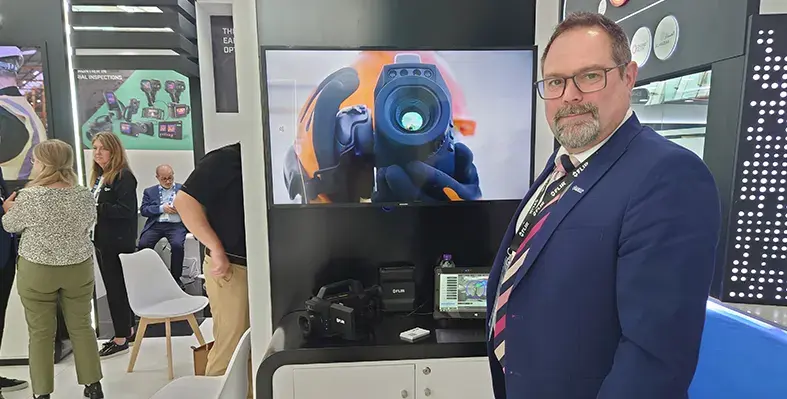
Stephen Beynon demonstrates FLIR's OGI cameras at ADIPEC. (Image source: Alain Charles Publishing)