A quiet revolution is underway as offshore platform developers bring a new generation of all-electric free-fall lifeboats into service, according to VIKING Life-Saving Equipment
The leading marine and offshore solutions provider says battery power improves lifeboat performance, reliability, cost efficiency and sustainability, as well as operational safety.
For lifeboat operators, all-electric power is increasingly accepted as a viable alternative to conventional diesel-based propulsion, with advances in battery technology pointing toward enhanced performance as power density increases. VIKING Life-Saving Equipment has already delivered its E-GES (Electrical Gravity Escape System) free-fall lifeboats to several well-known companies in the offshore sector.
Smooth operations
Electric propulsion offers several operational benefits for lifeboat operators, including lower levels of vibration, a quieter cabin with better air quality, increased acceleration, and higher top speeds,” says Erik Mostert, VIKING’s senior technical sales manager Oil & Gas. “These advantages enable electric lifeboats to transport evacuees more comfortably and quickly than diesel-powered boats.”
Battery power also allows the asset owner to dispense with the need to transport, store, and handle diesel fuel on the platform, adds Mostert, eliminating the associated risk of fuel contamination. For operators working in areas affected by hydrogen sulphide gas clouds, electric propulsion offers a further benefit: because the battery provides the entire power supply, there is no need to draw air from outside when the lifeboat is in operation. This means the boat can operate autonomously for up to two hours in such environments, compared with 10 minutes for a diesel-powered boat.
Beyond these immediate operational advantages, electric propulsion offers potential benefits in reliability, accident prevention, maintenance, and through-life costs.
The design of VIKING’s GES free-fall lifeboats reflects the industry’s wider emphasis on safety. Their structure follows the principles underpinning DNV-ST-E406, a lifeboat performance standard that goes beyond the requirements of the International Convention for the Safety of Life at Sea (SOLAS), specifying no harmful accelerations in up to 100-year storm conditions.
The compact, lightweight davit installations used with these lifeboats also play an important role in safe and efficient operations. Built to the NORSOK 002 standard, they incorporate dynamic considerations drawn from crane safety rules, alongside maritime regulations and provisions intended to simplify operation for users.
“Together, these design considerations provide a broader context for the adoption of electric propulsion, whose benefits extend beyond the performance of the lifeboat itself,” comments Mostert.
Remote risks
Today, the ‘not normally manned platform’ is an increasingly common feature of the offshore industry, as operators prioritise reducing the number of personnel working in-field. Recent advances in connectivity, digitalisation, and remote management have enabled asset managers to automate processes and control others from onshore or remote control rooms.
However, having been formulated with diesel engines in mind, SOLAS maintenance procedures require lifeboat engines to be run for up to five minutes every 14 days to ensure and validate they are fit for purpose. The diesel lifeboat check is also the first compliance task assigned to a maintenance crew boarding a platform, with any failure having consequences for the crew’s own ability to evacuate the facility.
A lifeboat featuring electric propulsion can be fully verified remotely, removing both the on-site check requirement and any risk to maintenance crew site evacuation.
The electric solution also mitigates for risks associated with the way a free-fall lifeboat’s diesel engine, tilted at an angle of up to 35 degrees and cold-started every two weeks, will lose performance over time.
VIKING’s E-GES-45 (60-person capacity) and E-GES-52 (70 person capacity) free-fall lifeboats are typically powered by three to four battery units housed in robust waterproof cases (IP-67), with individual cells thermally insulated. They also incorporate ventilation, gas and smoke detection, and an additional cooling system to support battery shut down when necessary.
Connected to safety
Since electric systems are compatible with remote maintenance, operating systems can be checked from land to confirm that the lifeboat’s propulsion system is available when required, including on platforms that are not normally crewed.
As well as eliminating the risks associated with physically accessing the lifeboat, remote diagnostics, maintenance, and control methods can extend the interval between service engineers’ visits from once every 14 days to once a year.
Maintaining a diesel-powered lifeboat is estimated to require more than 300 hours of work annually. With tests of the deluge, steering, and hook-release systems carried out remotely, and launches simulated rather than carried out physically, analysis indicates that equivalent procedures for an electric lifeboat can be completed in 90% less time.
“VIKING lifeboats also feature self-diagnostic programmable logic controller systems, with each boat connected to an individual email address that alerts maintenance teams to issues in monitored parameters including temperature, charge, gases, and fumes,” says Mostert. “In one instance, a lifeboat alerted the team to a malfunctioning battery charger that required attention.”
Electric lifeboats lead the charge to offshore safety
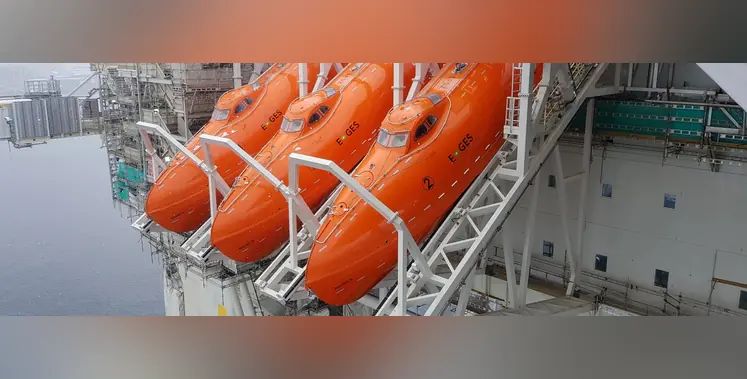
. VIKING Life-Saving Equipment has already delivered its E-GES (Electrical Gravity Escape System) free-fall lifeboats to several well-known companies in the offshore sector.