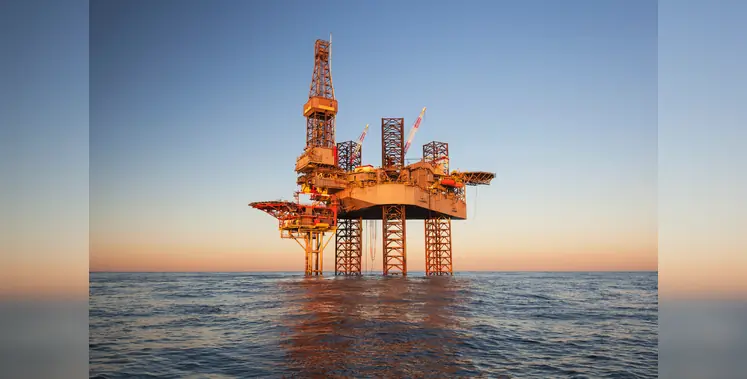









Chevron has started drilling a new well in the Nargis natural gas field in the Mediterranean Sea, as part of ongoing efforts to develop the field, discovered in 2022
The project is being developed by Chevron as the main operator, in partnership with Eni, as well as Mubadala Energy and Tharwa Petroleum Company. The Nargis field is located in the prolific East Nile Delta Basin of the Mediterranean Sea, approximately 50 km offshore.
Eng. Karim Badawi, Minister of Petroleum and Mineral Resources, reviewed the launch of drilling activities aboard the drilling vessel Stena Forth, recently arrived in Egypt to begin operations at the field.
The Minister said that the drilling of the new well is part of the Ministry of Petroleum and Mineral Resources' strategy to encourage international energy companies to accelerate the development of untapped gas discoveries, including the Nargis Field, and bring them into the development and production portfolio.
The Egyptian government is encouraging investment and incentivising exploration and production to reverse years of decline and reduce energy imports, a drive which is being given additional impetus by the current situation in the Middle East. These efforts seem to be paying off, with a high level of exploration activity and a number of promising discoveries being made.
The most recent is the discovery by Agiba Petroleum Company, the joint venture between the Egyptian General Petroleum Corporation (EGPC) and Eni, in the Western Desert, representing the company's most significant discovery over the past 15 years.
The Ministry announced that the discovery was achieved through the South Bostan-1X exploratory well, drilled using the EDC-9 rig operated by the Egyptian Drilling Company (EDC). Preliminary estimates indicate reserves of approximately 330 bcf of gas and 10 million bbl of condensates and crude oil, with total estimated recoverable reserves reaching 70 million bbl of oil equivalent.
The significance of the new discovery is further enhanced by its proximity to existing facilities and infrastructure, which will enable its rapid development and swift tie-in to the production network.
The well encountered multiple sandstone and limestone reservoirs, with a net pay thickness of 400 feet, highlighting the discovery's strong economic potential and production significance.
The new discovery reflects the success of the Ministry of Petroleum and Mineral Resources' incentives to encourage partners to intensify exploration activities in areas adjacent to existing fields. This approach has facilitated the identification of new discoveries in close proximity to established infrastructure and production facilities, eliminating the need for significant new infrastructure investments. As a result, development costs are reduced, time to first production is accelerated, and operating efficiencies are enhanced
In early May Eni made a new natural gas discovery in the Nile Delta region, with estimated production rates of around 50 Mmcf/d, following its gas and condensate discovery in the Temsah concession in the Eastern Mediterranean in April, with preliminary estimates of about 2 trillion cubic feet of gas and 130 million barrels of associated condensates.
Also this year, Dragon Oil announced a new oil discovery following the successful drilling of the South El Wasl ‘B.B2’ exploration well in the Gulf of Suez, with initial results indicating production rates above 2,000 bpd of oil. While US Apache, in collaboration with the Egyptian General Petroleum Corporation (EGPC), made a new natural gas discovery in the Western Desert, following the drilling of the SKAL-1X exploratory well in the South Kalabsha area, with initial test results indicating a daily production rates of approximately 26 million cubic feet (mmcf) of natural gas and 2,700 barrels of condensate.
Chevron drills new well in Egypt’s Nargis gas field