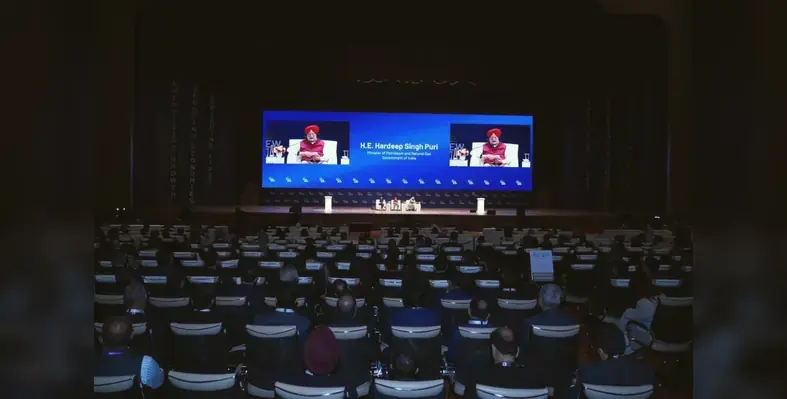









India Energy Week (IEW) 2026 opened on 27 January in Goa, bringing together global policymakers, energy ministers, CEOs, investors and innovators to discuss the big energy issues of the day
With representatives from nearly 125 countries, the opening day included key speeches from leading global figures, highlighting India’s influence at a time when global energy systems are undergoing transformation.
Addressing the inaugural ceremony through a video link, Prime Minister Shri Narendra Modi highlighted India’s expanding role in energy markets and as a driver for global energy demand.
“India is a land of immense opportunities for the energy sector,” the Prime Minister said. As the world’s fastest-growing major economy, India’s demand for energy is rising continuously - and at the same time, India offers the capacity and capability to help meet global demand.
Prime Minister Modi highlighted that India is among the top five exporters of petroleum products, supplying more than 150 countries worldwide. He emphasised the opportunities for India’s large refining base - currently the world’s second largest.
The Prime Minister also highlighted the landmark Free Trade Agreement between India and the European Union, describing it as a remarkable example of coordination between two of the world’s largest economies.
Outlining India’s ambition, Prime Minister Modi said the country was moving beyond energy security towards the mission of energy independence, supported by wide-ranging reforms, deep-sea exploration initiatives, LNG infrastructure expansion and rapid growth in city gas distribution.
“Our energy sector lies at the heart of India’s aspirations,” he said. “It holds US$500bn in investment opportunities. That is why Make in India. Innovate in India. Scale with India. Invest in India.”
In a keynote address, Dr. Sultan Al Jaber, UAE Minister of Industry and Advanced Technology, and managing director and group CEO of ADNOC, forecast that global oil demand will remain above 100mn bpd through 2040, with demand for both LNG and electricity to grow by 50% or more, encouraging leaders to embrace the “transformative opportunity” of rising global energy demand.
He underlined three powerful megatrends impacting the energy industry: the rise of emerging markets, the exponential growth of artificial intelligence (AI), and the transformation of energy systems
Electricity demand will be driven not only by AI and data centres but increasingly by cooling, he added. Global air-conditioner numbers are projected to more than triple to 5.6 billion by 2050, equivalent to ten AC units sold every second for the next thirty years.“Demand at this scale and pace requires investment in all forms of energy,” Dr. Al Jaber said, adding, “The biggest risk is not over supply, it is underinvestment.”
Dr. Al Jaber highlighted the strong partnership between the UAE and India, noting ADNOC’s role as a crude supplier for India’s growing refining demand, as well as supplier of LPG, feedstocks and chemicals. India is ADNOC’s number one LNG market. The UAE is also supporting India’s clean energy ambitions through ALTÉRRA, the world’s largest private climate investment vehicle, he added, with investments totalling 11GW across wind, solar and battery storage.
“Progress and growth at this scale and pace requires a special kind of partnership,” said Dr. Al Jaber said. “Partnership that is strategic, long-term, agile and flexible. Steadfast, dependable, principled and consistent. Partnership that is based on trust and will endure through thick and thin. This is precisely what defines the UAE-India relationship.”
India opportunities underlined at opening of India Energy Week