







Security through energy diversification is the name of the game for Bahrain's integrated energy company Bapco Energies, as Mark Thomas, the company’s group chief executive explained in a fireside chat at the Energy Institute’s International Energy Week in London
Increased geopolitical disruptions, uncertainty and volatility have brought energy security to the top of the agenda, with one of the lessons for Europe being the danger of relying on a single source of energy.
Introducing the session, entitled ‘Broadening the energy pool: ensuring security in a fragmented landscape’, Amy Bowe, director Oil Research at LSEG, noted the increasing fragmentation of the energy landscape, with the Russia and Ukraine war introducing the first fracture in a veneer of connectivity and highlighting the pitfalls of the dependence on energy imports. This has accelerated over the past year or so, with multiple geopolitical events, increasing sanctions measures and new tariff and trade policies causing friction and resulting in significant shifts in trade flows. How have these and other risks impacted the business of Bapco Energies?
Mark Thomas pointed out that while Bahrain has had a continuous oil and gas business since 1932, this is small compared to that of its neighbours, and the Kingdom is in fact a net importer of energy. While it has been able to develop its industrial sector, thanks to a large onshore gas reserve, and now has a modernised and updated refinery along with petrochemicals, steel and aluminium, the country needs to diversify its energy supply in the future to meet its economic growth targets.
Energy diversification
“That diversification will include LNG,” he said, “Last year Bahrain imported around half a million tons of LNG, and this year we’re looking to import probably one and a half million tons of energy to meet demand.
“So as a strategy, not only are we responding to the geopolitical changes and so on, we’re responding to our own internal needs to look at diversification of energy supply in order to support GDP growth and the energy backbone that will allow that GDP growth to happen.”
Bahrain’s ambitions to grow its economy cannot happen without a corresponding growth in energy, he said, particularly given the potentially high intensity energy demand from data centres.
Meeting increasing energy demand growth while ensuring its can meet the Kingdom’s ambitious energy transition goals, including net zero by 2060, will require a reduction of emissions intensity per GDP. How is Bapco Energies looking to meet that challenge?
Thomas said the company aims to balance responsible oil and gas production with clean energy development, including solar and nuclear, to support Bahrain's GDP growth and energy security. While oil and gas will continue to be the energy backbone for the next decade, the company is also looking at developing giga scale renewable energy such as solar, as well as nuclear. Given the Kingdom’s small land mass and limited space available for solar, it is looking to cooperate with neighbouring countries. At the same time, it is looking to reduce emissions from oil and gas, for example through carbon capture.
“It’s not either or, it’s all sources of energy, because energy demand is growing and we have to keep up with it, or economies cannot grow at the pace they need to. So for Bahrain, we are looking at how we produce renewable energy for the future, while not inhibiting economic growth which today is supported primarily through natural gas.” The company is therefore looking to support the energy transition in a practical, balanced way.
Thomas highlighted the emphasis on the diversification of energy sources, given the danger of relying on one source of energy supply, as illustrated by Europe’s reliance on Russian gas. This is the foundation of Bahrain’s energy strategy.
“That will include continuing with our domestic natural gas, but also looking at LNG as a bridge, large-scale renewables, whether solar or wind, and small modular reactors (SMRs).” In the meantime, before large-scale substitutional projects come online by around 2030, the Kingdom will continue to import LNG to balance the energy load.
“So we will go from a single source to probably six or seven different sources of energy, while also looking to import energy from our neighbours who may have an abundance of energy,” he said.
Comparing Bahrain’s situation to that of Europe, Thomas said that Bahrain is reacting to a supply limitation on energy, while Europe is reacting principally on a regulatory basis to control demand. “So we are different, but trying to address a similar problem,” he said. He added that the geopolitical tensions of the past couple of years had impacted Bapco Energies throughout its business. For example, when Gulf tensions were high it had impacted maritime traffic and threatened to disrupt Bahrain’s LNG supply, which would have had a knock-on impact on its power generation capabilities.
Refinery success
Thomas went on to speak about the US$7bn project to upgrade the 75 year-old Sitra refinery with the latest technology. The refinery now has a capacity of 380,000 bpd with new units added, and has achieved the highest standards in terms of product quality, energy efficiency and emissions reduction.
Thomas commented that this has been a big success and that Bapco Energies is working with international partners like EOG, BP, Chevron and TotalEnergies, to expand the market for its products.
“We’re seeing diesel show up in Brazil and jet fuel show up in Australia. We never saw this before. So the geopolitical climate and some of the ramifications of that changes our supply chain, changes where we put our product. Sometimes it’s beneficial, sometimes it’s not.”Thomas also highlighted Bapco Energies’ new trading joint venture with TotalEnergies, BxT trading, which operates out of Dubai and will support Bahrain's oil industry by leveraging its downstream portfolio to maximise value and broaden its access to global markets, enhancing Bapco Energies’ global trading capabilities, strengthening its downstream value chain, and reinforcing Bahrain's position as a competitive and trusted player in the international energy markets.
“It’s the first time to my knowledge that an international oil company has opened its trading business up to a joint venture partner,” Thomas said, explaining that it involves physical trading of the refinery’s products, purchasing third party products and derivative trading.
Thomas underscored the importance of collaboration to create efficiencies and remain competitive in the global energy market.
“I think the bottom line is energy is a global commodity, and no matter how much you try to lock it in one place, it’s going to flow across borders. To go it alone is an impossible task. The only way to be successful in this business over the long term is to partner with the best people you can. That’s what we do at Bapco Energies. That’s what we do as the Kingdom of Bahrain. We look for the latest technology providers and we look for good partners with global reach. The nature of the business is free flowing, cross border transactions to meet demand and supply, and the moment you start interfering with that basic supply and demand you get inefficiencies. In some cases, that’s what we’re seeing today. It’s an interesting dynamic we’re seeing right now.”
Ensuring security in a fragmented landscape
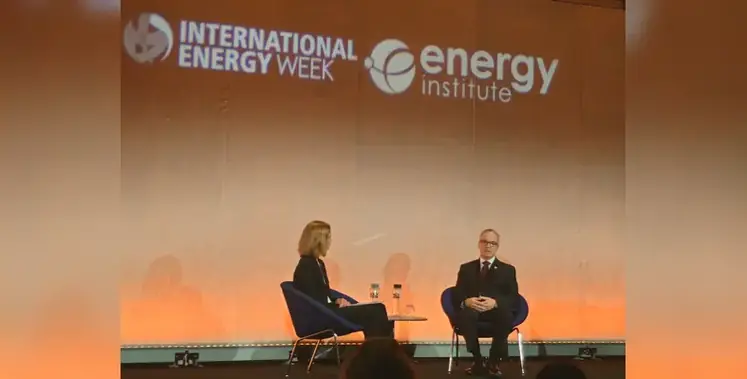
Mark Thomas, group chief executive of Bapco Energies in conversation with Amy Bowe, director Oil Research at LSEG. (Image source: Alain Charles Publishing)