In an exclusive interview with Oil Review Middle East, Thomas Löffler, executive vice president, dmg events discusses what we can expect at ADIPEC this year
Oil Review Middle East: At this time of geopolitical volatility, rising energy demand and infrastructure constraints, how will ADIPEC help to advance the investments, projects and partnerships required to support the delivery of secure, reliable and affordable energy systems?
Thomas Löffler: The last few months have reinforced something important: the energy system that was carefully built over decades is no longer the system the world now needs. We need a system that can absorb shocks, adapt to changing conditions and continue delivering the energy required for long-term economic and societal progress. That is why energy security is economic stability, and resilience has become fundamental to both.
The imperative is now twofold: secure the energy the world relies on today, while investing in the infrastructure, technology and capabilities needed to expand capacity and strengthen resilience for the future. That requires significant capital, faster execution and much closer collaboration across sectors and borders.
ADIPEC 2026 is where those priorities come together. Across the Strategic and Technical Conferences, Leadership Roundtables and the exhibition, we bring together governments, energy producers, investors, technology companies, engineers, manufacturers, infrastructure providers and major energy consumers to address the practical questions that determine delivery: where capital needs to go, what makes projects bankable, how infrastructure can be built faster and how technology can move from pilot to scale.
Collaboration is critical because no single company, country or sector can deliver the next energy system alone. ADIPEC brings together the full breadth of the global energy industry, from every part of the world, creating the conditions for ideas to become decisions, partnerships to become projects and investment to translate into real-world capacity. As a global centre for energy, investment and technology, Abu Dhabi and the UAE are uniquely positioned to convene those conversations and help accelerate progress.
Given the convergence of rising energy demand, AI-driven power growth, infrastructure constraints and geopolitical volatility, this is one of the most important editions of ADIPEC in recent years. The focus is not simply on discussing the challenges facing the industry, but on strengthening supply, mobilising capital, accelerating technology deployment and advancing the partnerships needed to build a more resilient energy system for the future.
Oil Review Middle East: What will be the key themes and topics at ADIPEC this year, and how has the strategic conference been refreshed to reflect changing priorities?
Thomas Löffler: The Strategic Conference has been significantly refreshed this year to reflect the issues now determining how the global energy system develops and performs. At its core are three priorities: strengthening energy security and resilience; mobilising the capital and infrastructure required to meet rising demand; and embedding intelligence and technology across energy systems to improve performance, reliability and decision-making.
New programmes include Energy Security & Resilience; Policy, Regulation & Governance; Upstream; Clean Power, Molecules & Carbon Management; Grids, Infrastructure & Industrial Execution; and Workforce & Skills, alongside updated programmes focused on AI, digital technology and integrated industrial value chains.
These changes reflect how interconnected the industry has become. Energy security cannot be separated from infrastructure and investment. AI is both changing how energy systems operate and creating significant new demand for power. And delivering projects at the scale required will depend as much on regulation, workforce capability and partnerships as it does on technology.
There is also a much stronger emphasis on execution. The conversation is no longer simply about long-term ambition. It is about what makes projects investable, how capital moves into infrastructure, how technology gets deployed at scale and how partnerships accelerate delivery.
Ultimately, the programme is built around the decisions the industry needs to make now — where to invest, what to build, which technologies to scale and how to deliver the capacity the world will need.
Oil Review Middle East: What is the role of the ADIPEC exhibition and its specialised zones in showcasing the latest innovations and technologies and catalysing commercial partnerships?
Thomas Löffler: The exhibition is where a lot of the commercial activity at ADIPEC happens. More than 2,250 companies come together not simply to showcase technology, but to meet customers, identify project opportunities, build partnerships and move solutions closer to deployment.
Across 16 halls, 30 country pavilions and four specialised zones, the exhibition connects energy companies, technology providers, manufacturers, service companies, investors and project partners in one commercial environment.
The AI Zone shows how AI, robotics, automation and advanced analytics are moving from pilot to real-world deployment across energy assets and operations, while the Digitalisation Zone focuses on the digital infrastructure, automation, analytics and cybersecurity capabilities making energy systems more connected, responsive and resilient.
The Low Carbon & Chemicals Zone brings together technologies and commercial models spanning carbon management, lower-carbon solutions, chemicals and advanced materials; and the Maritime & Logistics Zone focuses on the shipping, ports, supply chains and infrastructure required to keep global energy flows secure, efficient and reliable.
These zones play an important role in bringing operators, technology companies, project owners and investors into the same environment. That is where technology moves from being demonstrated to being evaluated, financed and deployed.
Oil Review Middle East: With the rapid expansion of AI and the transition from pilot projects to large-scale deployments, and as AI safety concerns come to the fore, how will ADIPEC shape the effective and responsible deployment of AI and intelligent energy systems?
Thomas Löffler: As AI moves into mission-critical energy infrastructure, the focus must extend beyond capability to include governance, transparency, cybersecurity and human oversight. ADIPEC will bring together operators, technology providers and policymakers to ensure AI is deployed safely, responsibly and at scale.
The AI Zone will show how artificial intelligence, robotics, automation and advanced analytics are moving from pilot to real-world deployment across energy assets and operations. At the same time, the AI, Digital & Technology conference programme will bring energy and technology leaders together to examine how these technologies can improve performance, strengthen resilience and support increasingly complex energy systems.
That depth extends across ADIPEC. Some of the world’s most influential energy and technology leaders will be part of the conversation this year, including Dr Roland Busch, President & CEO, Siemens AG; Olivier Blum, CEO, Schneider Electric; Caspar Herzberg, CEO, AVEVA; Girish Rishi, CEO, Cognite; Dennis Jol, CEO, AIQ; Uljan Sharka, Founder and CEO, Domyn; Dr Olivier Oullier, CEO, Inclusive Brains; and Tim Bawtree, Chairman and Founder, Quantum Switch.
Bringing that level of leadership together with more than 2,250 exhibiting companies, investors, project owners, engineers and technology providers is what creates the opportunity for ideas to move into partnerships, investment and deployment.
The point is not scale for scale’s sake. It is what that scale enables: bringing the people developing technology together with the companies that need it, the investors that can finance it and the decision-makers who can take it to market.
Energy security and resilience come to the fore at ADIPEC 2026
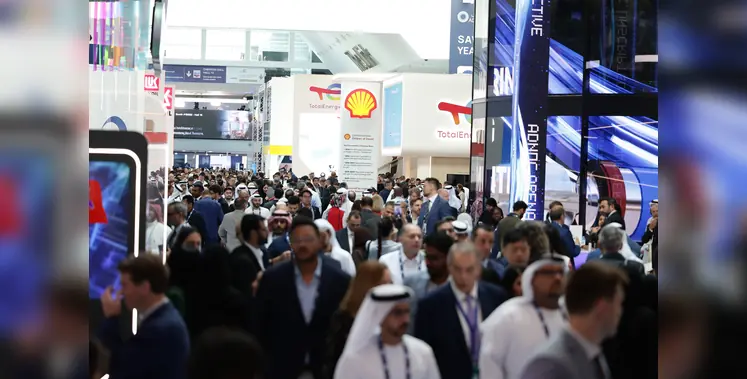
ADIPEC 2026 will feature more than 2,250 exhibiting companies. (Image source: dmg events)