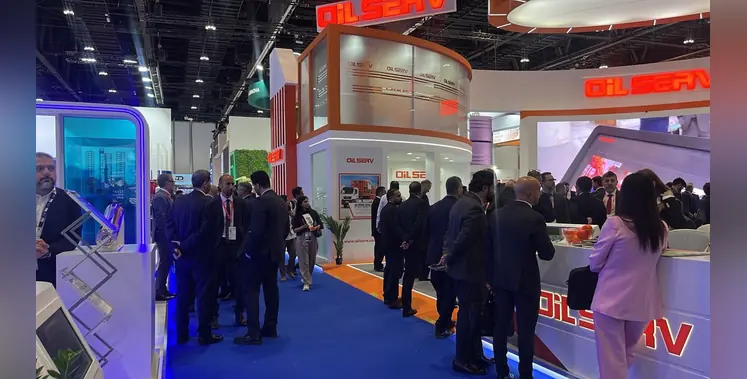
ADIPEC 2026 has opened in Abu Dhabi, bringing together more than 40 ministers, alongside policymakers, regulators, global CEOs and decision-makers to advance the decisions, partnerships and investments needed to strengthen energy security and support long-term economic growth
Taking place from 2-5 November at the Abu Dhabi National Exhibition Centre (ADNEC), ADIPEC 2026 is set for its biggest exhibition to date, with a record 2,260 exhibiting companies, 16 halls fully booked, 30 country pavilions and more than 239,000 attendees expected from over 170 countries. Among the participants are 54 national and international oil and energy companies (NOCs, IOCs, NECs and IECs), including bp, TotalEnergies, Eni, Oxy, ExxonMobil, Chevron, NNPC and INPEX. Major technology and industrial companies including Siemens AG, IBM and Microsoft will also participate.
Held under the patronage of His Highness Sheikh Mohamed bin Zayed Al Nahyan, President of the UAE, and hosted by ADNOC, ADIPEC 2026 takes place at a critical time for the global energy industry. Rising energy demand, geopolitical shifts and growing infrastructure requirements are placing energy security, resilience and investment at the centre of global economic priorities.
Keynote address
Delivering a keynote address at the opening ceremony, His Excellency Dr Sultan Ahmed Al Jaber, UAE Minister of Industry and Advanced Technology and ADNOC managing director and Group CEO, set the direction for four days of strategic dialogue and commercial engagement.
He highlighted that energy security has shifted from a specialist topic to a critical concern for every industry and household. Global supply buffers have eroded, evidenced by the loss of nearly 1bn barrels from inventories due to disruptions in the Strait of Hormuz. In some markets, stocks of diesel are at their lowest seasonal level in 35 years, while others are facing a 600 billion cubic feet LNG supply gap.
“But supply is only half the story. The other half is delivery. Before the disruption, logistics were less than 5% of the cost of a barrel. Today, they are more than 30%. In short, energy security is not only measured at the point of production. It is now also measured at the point of delivery.”
Five key steps for energy resilience
Dr. Al Jaber outlined five steps the energy industry can take to reduce the impact of future shocks.
“First accessible supply. We need expanded strategic storage, larger stockpiles of products and flexible refining capacity closer to consumer markets.
“Second, routes to market. Supply only counts when it arrives. Infrastructure must be built before it is needed and enabled by advanced logistics.
“Third, operational intelligence. Moving from automation operations to intelligent energy systems that anticipate risk, optimise performance and drive down the cost of every barrel.
“Fourth, capital follows confidence. Policy must create it, finance must accelerate it and insurance must keep trade moving.
“Fifth, which is in my view the most important, is people. Because behind every barrel that arrives is a person who made sure it did. Systems don’t carry responsibility, people do.”
Dr. Al Jaber praised the UAE’s armed forces, Civil Defense, firefighters, first responders and ADNOC’s front line employees for their selfless service in testing times and also acknowledged regional and global partners in the energy community for their contribution to keeping energy flowing during this period.
Dr. Al Jaber paid tribute to the example set by His Highness Sheikh Mohamed bin Zayed Al Nahyan, President of the UAE, highlighting his leadership and the values of unity and belonging that underpin the country’s resilience.
“Talent stayed. Capital stayed. Investment kept coming and the economy kept moving. That is the UAE model, pressure-tested and proven by results.
“The UAE will always advocate for dialogue, active diplomacy and pursue political solutions that bring stability to markets, to energy flows and to the global economy.”
Reflecting on the UAE’s resilience during recent market disruptions, Dr. Al Jaber said, “We did not write our resilience playbook during this disruption. We wrote it years before. And at ADNOC, it did not make us immune, it made us prepared. Our leadership’s foresight in modernising ADNOC made the difference, from integrated trading, to investing in people, to world-class logistics, to XRG’s global portfolio in gas, chemicals and energy solutions.
“The evident result is our end-to-end AI-enabled operating model, built for a world of rising demand and delivering what customers need, when they need it, where they need it.”
AI initiatives
Dr Al Jaber announced a new agreement between ADNOC, OpenAI and G42 as an example of how strategic collaboration and advanced AI can help reshape the energy industry, to optimise energy production and meet rising global demand. This collaboration will make ADNOC the world’s first energy company to deploy OpenAI Frontier to create smarter, safer and more resilient energy systems.
“From the moment ChatGPT was born, the world has asked what energy can do for AI. And now, together, we will find out what AI can do for energy.”
Following on from this, the gathering was addressed by Sam Altman, CEO of OpenAI who noted that while the AI industry has long requested energy, AI can now repay the favour by optimising the energy sector, describing the current era as a “new renaissance” where AI enables humans to solve complex problems and innovate at scale.
He praised the UAE as “the most forward looking country in the world for AI adoption” and noted the partnership with G42 and ADNOC is an opportunity to apply frontier AI models to the hardest problems in the energy industry, suggesting companies should “dream bigger” regarding what is possible with current advanced AI models. He stressed however that humans must remain in control of the future, ensuring
AI serves as a tool for people rather than a replacement for human agency.
“This is a value that we intend to really go fight for.”
ADIPEC 2026 opens in Abu Dhabi