









The disruption to energy supply through the Strait of Hormuz is spurring governments to reduce dependence on imported oil and gas, according to the tenth edition of DNV's Energy Transition Outlook
Energy-importing countries are scaling clean energy three times faster than energy exporters, as governments seek to reduce reliance on imported oil and gas by expanding domestically produced power.
At the same time, exporting countries outside the Middle East are increasing production to compensate for disrupted supplies, and decarbonising more slowly compared to the rest of the world.
China, India, and Europe have collectively shifted towards non-fossil energy more than three times as fast as the Middle East, North America, and Russia.
Prolonged conflict would permanently reduce fossil-fuel demand
The disruption to the Strait of Hormuz has strengthened incentives for importing countries to diversify supply and reduce their exposure to oil and gas, increasing the long-term risks facing fossil-fuel exporters. DNV’s new forecast sees the Middle East supplying around 40% of global oil production in 2050, compared with 50% in last year’s Outlook.
“Energy security is redrawing the map of the energy transition,” said Ditlev Engel, CEO - Energy Systems at DNV. “Importing regions are accelerating electrification, renewables, and storage to reduce their exposure to the most insecure fossil-fuel markets. Exporters, meanwhile, are responding to today’s shortages by increasing investments and production. The result is a widening divide in the speed and direction of the transition.”
Technology gap widening
The gap is widening between competitive mature technologies and emerging technologies with falling costs accelerating the deployment of solar power, onshore wind, and batteries, while more expensive emerging technologies are losing ground. Solar PV and onshore wind are increasingly displacing fossil fuels from power generation, and installed battery capacity has increased 14-fold over the past five years.
However, technologies essential to decarbonising the hard-to-electrify sectors, such as hydrogen and carbon capture, are falling back due to their high cost and concerns about industrial competitiveness. Stronger policy support will be needed to bridge the cost gap and accelerate deployment.
DNV forecasts that nuclear will maintain its current share of global power generation as electrification accelerates. Installed nuclear capacity is expected to grow by 30% over the next decade and by 170% by 2060, despite high costs and supply-chain risks.
“Driven by solar, wind, and increasingly battery storage, electricity is emerging as the clear winner of the energy transition,” said Sverre Alvik, Director of Energy Transition Research at DNV. “The pace of electrification over the next two decades will be more than twice that of the past two decades. Although importing countries are leading the shift, fossil-fuel exporters are also embracing electrification because it delivers greater efficiency and lower costs.”
AI is significantly boosting electricity demand. DNV forecasts that global data centre electricity consumption will almost triple from around 400 TWh in 2025 to 1,100 TWh in 2030, with growth concentrated initially in North America.
MENA region key takeaways
• The Middle East and North Africa is balancing energy security and transition goals, maintaining oil and gas exports while scaling renewable and low-carbon energy investments.
• Solar is becoming a key growth driver, supported by abundant resources, cost competitiveness, and strong government backing.
• Power demand will grow substantially, driven by economic expansion, electrification, cooling, desalination, and hydrogen production.
• GCC countries are reducing the carbon intensity of hydrocarbons, focusing on electrification, methane reduction, efficiency improvements, and carbon capture.
• Hydrogen is emerging as a major export opportunity, leveraging the region’s energy resources and infrastructure.
• Climate resilience is becoming a business imperative, as heat, water scarcity, and other climate risks increasingly impact economic growth and operations.
Supply disruption drives energy importers to accelerate clean energy
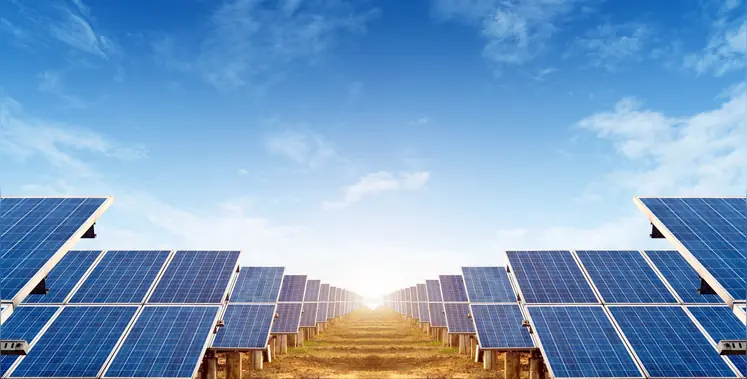
Energy-importing countries are scaling clean energy three times faster than energy exporters. (Image source: Adobe Stock)