








The global hydrogen economy is evolving and is entering a new inflection point in 2026 amid shifting market realities, policy uncertainties and execution challenges
That’s according to Hydrogen in Oil and Gas, a new report from leading intelligence platform GlobalData, which reveals that as of February 2026, active low-carbon hydrogen capacity stood at around 2.2 million tonnes per annum (mtpa), with over 460 projects in operation, compared to 104 in 2020. However, demand uncertainty and limited investment are barriers constraining the development of new low-carbon hydrogen projects, particularly in North America, where policy change has negatively impacted certain high-profile projects.
GlobalData projects that global hydrogen production capacity could reach 82.3 mtpa by 2030, taking into account the active under development projects, but around 57% of projects due to start by then are still at the feasibility stage, and are unlikely to be commissioned on schedule.
Ravindra Puranik, Oil and Gas Analyst at GlobalData, commented, “Despite an impressive increase in count of active low-carbon hydrogen projects, capacity additions remain far below the levels needed to meet the near-term targets set by the IEA Net Zero Emissions (NZE) scenario.”
GlobalData notes the scarcity of large-scale projects, with only 10 of the 2,335 upcoming projects worldwide having capacities exceeding 1 mtpa and a few others touching the 0.5 mtpa mark. Among the 10 high-capacity projects, nine are for green hydrogen, and one is for blue hydrogen.
Puranik continues: “Despite accounting for the bulk of the project numbers, the cumulative capacity of green hydrogen initiatives remains relatively modest. Thus, their output is not large enough to displace established energy sources, such as natural gas or utility-scale renewables. Developers face significant challenges in scaling up, including overcoming infrastructure constraints, securing long-term offtake agreements, and ensuring financial viability. Until more large-scale progress through the development pipeline, hydrogen’s share in the global energy mix will likely remain constrained.”
“Looking ahead to 2030, global low-carbon hydrogen capacity is expected to expand once demand picks up, backed by increased private investment and supportive policy frameworks, as it is a critical energy source to achieve corporate net-zero commitments. Nevertheless, achieving these ambitions will require overcoming persistent financial, regulatory, and infrastructure barriers in the near term to ensure that project announcements translate into operational capacity by the end of the decade.”
Among oil and gas majors, BP leads in green hydrogen, with nearly 3 mtpa of active and upcoming capacity with projects in Mauritania, Australia, and across Europe. TotalEnergies has also increased its focus on green hydrogen projects, alongside industrial gas leaders like Air Liquide and Air Products. Meanwhile, Shell and Equinor are expected to lead in blue hydrogen capacity by 2030.
Middle East developments
As for the Middle East, DNV forecasts that region is on track to become the biggest hydrogen exporter by 2060 — not only sustaining its share of global hydrocarbon supply but potentially expanding it. By 2060, the Gulf Cooperation Council (GCC) is projected to produce 19 million tonnes of hydrogen annually, alongside significant growth in ammonia exports, DNV’s Oil & Gas Decarbonisation in the Gulf Region report says. Integrating hydrogen production with CCUS, renewables and existing industrial clusters will enable “cost-competitive pathways” that support decarbonisation across domestic and international value chains, DNV adds.
Currently, hydrogen demand in the GCC is driven almost entirely by its role as an industrial feedstock, but it is now evolving to a strategic energy carrier. Despite this transformation, hydrogen and its derivatives are projected to contribute just 3.1% of the region’s total final energy consumption by 2060 – well below the global average of 6%, according to DNV, reflecting both the region’s slower initial update of hydrogen and its abundant low-cost fossil fuel resources.
See more on DNV’s Oil & Gas Decarbonisation in the Gulf Region report in the latest issue of Oil Review Middle East here
Hydrogen progress constrained by demand and investment uncertainties
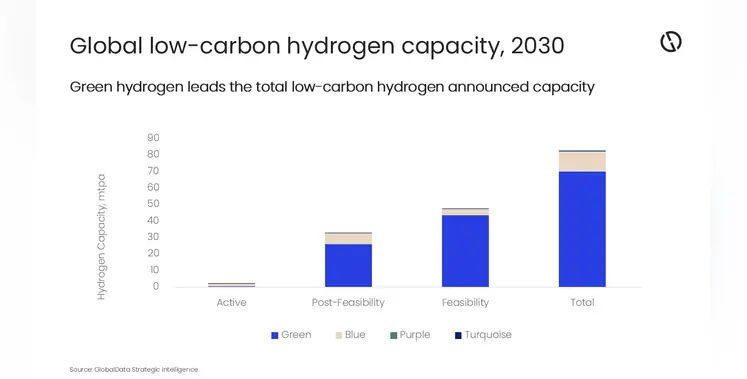
The majority of projects are still at a feasibility stage. (Image source: GlobalData)